On the same year and model of Kubota L3901, a 2WD will run $3,000 to $6,000 less than the 4WD version on the used market, and that gap is not arbitrary. It reflects real build cost, real wear parts, and real capability in mud and on slopes. Before you reflexively pay the premium or reflexively skip it, it pays to understand what the front drive actually does, where it earns its keep, and what it costs to maintain on a tractor with 4,000 hours on the clock.
The Price Premium Is Not Marketing
The 4WD version of a given tractor is typically 20 to 35 percent more on the used market, sometimes higher when inventory is thin. A 1998 JD 5410 2WD might sell for $13,000 while the MFWD version of the same year and hours sits at $17,500 to $19,000. On a Kubota L-series compact, the same spread holds. A used L3301 2WD at 800 hours runs around $13,500. The 4WD L3301 at similar hours is $17,000 to $18,500.
That spread exists because the 4WD version has a front differential, front axle shafts, a drop box or transfer gear, a heavier front axle housing, and larger front tires with drive lugs rather than rib tires. All of that is cast iron and steel that had to be manufactured, and all of it wears.
MFWD vs True 4WD
On anything under about 200 horsepower, "4WD" almost always means MFWD, which stands for Mechanical Front Wheel Drive. The rear axle remains the primary driver and the front axle engages through a drop box to add traction. Front and rear wheels are different sizes, and the front turns faster than the rear to compensate for the different circumference during turns. This is what you will find on a Kubota L3901, a JD 5075E, an MF 4707, a New Holland Workmaster. It is the right system for a small farm.
True articulated 4WD, where front and rear wheels are the same size and the tractor bends in the middle, is a row-crop and tillage category. A JD 8970, a Case IH Steiger, a Versatile. These are 200 to 600 PTO horsepower, weigh 15 to 30 tons, and have no business on a 40-acre hay farm. If you see an articulated 4WD advertised for a small acreage, the seller does not know what they have or they are hoping you do not.
Where 4WD Earns Its Keep
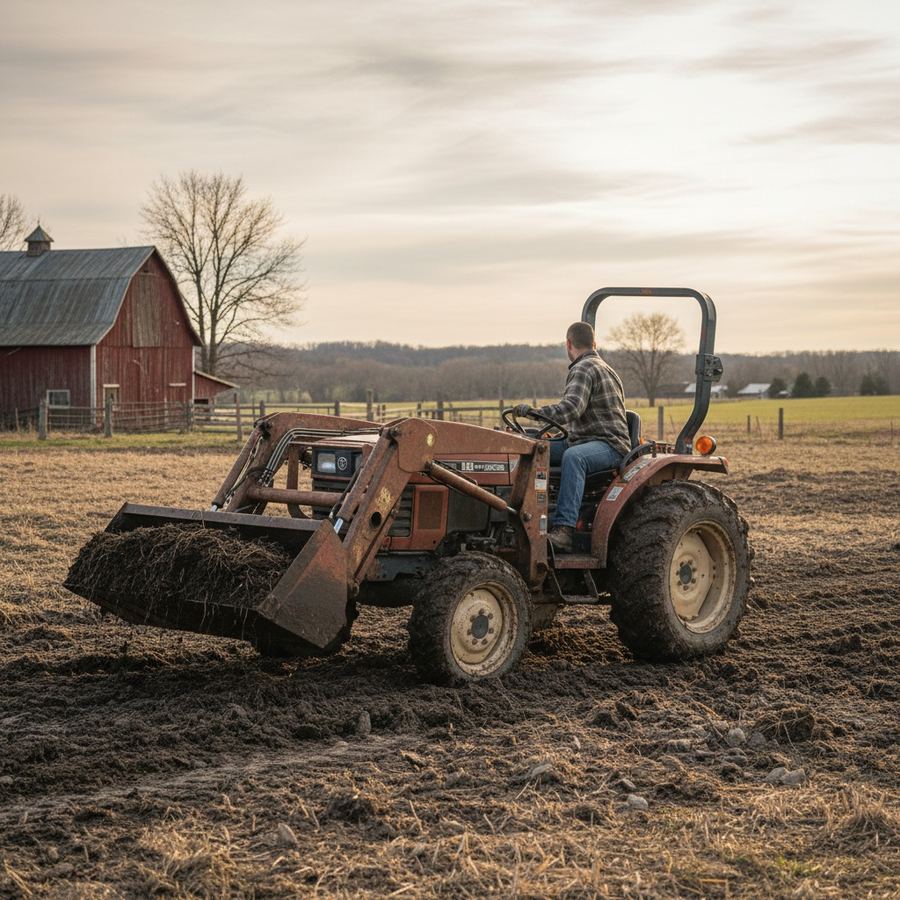
Loader work is the biggest single reason small-farm buyers should look hard at MFWD. A front loader puts downward weight on the front axle and lifts weight off the rear. The moment you scoop a full bucket of gravel or a large round bale, your 2WD rear drive wheels go light and lose traction. On wet ground, a 2WD with a loaded bucket will spin its rear tires and dig a hole. An MFWD pulls from the loaded end of the tractor and climbs out of the same situation without drama.
Hills are the second reason. Not gentle rolling pasture, but real grades. Anything above about 15 percent slope, you want front drive, especially if the ground is ever wet. Mowing a pasture with a 2WD utility tractor on a steep bank in spring with dewy grass is how people discover that a 5,000 pound tractor can slide sideways.
Snow plowing, food plot work on logging trails, hauling a manure spreader through a boggy gate, pulling a disc through tough sod. All of these are MFWD situations. Anywhere traction is more of a limit than horsepower, the front drive is worth the money.
Where 2WD Is Fine
Flat, dry pasture mowing with a rotary cutter? 2WD is fine. Light hay work on level fields, tedding and raking? 2WD is fine. Running a small PTO generator, a post hole auger, a spreader on dry ground? 2WD is fine. A tractor that lives in a barn and comes out to bush hog a field twice a year does not need front drive.
There is also a maintenance argument. A 2WD has no front differential to service, no front drive shaft U-joints to replace, no front axle king pin bushings wearing against each other, no front wheel hub seals leaking gear oil onto your rims. On a 30-year-old utility tractor, the 2WD has fewer failure points. A Ford 5000 or a JD 4020 in 2WD is a simpler machine to keep running than anything with a driven front axle.
Inspecting a Used 4WD Front End
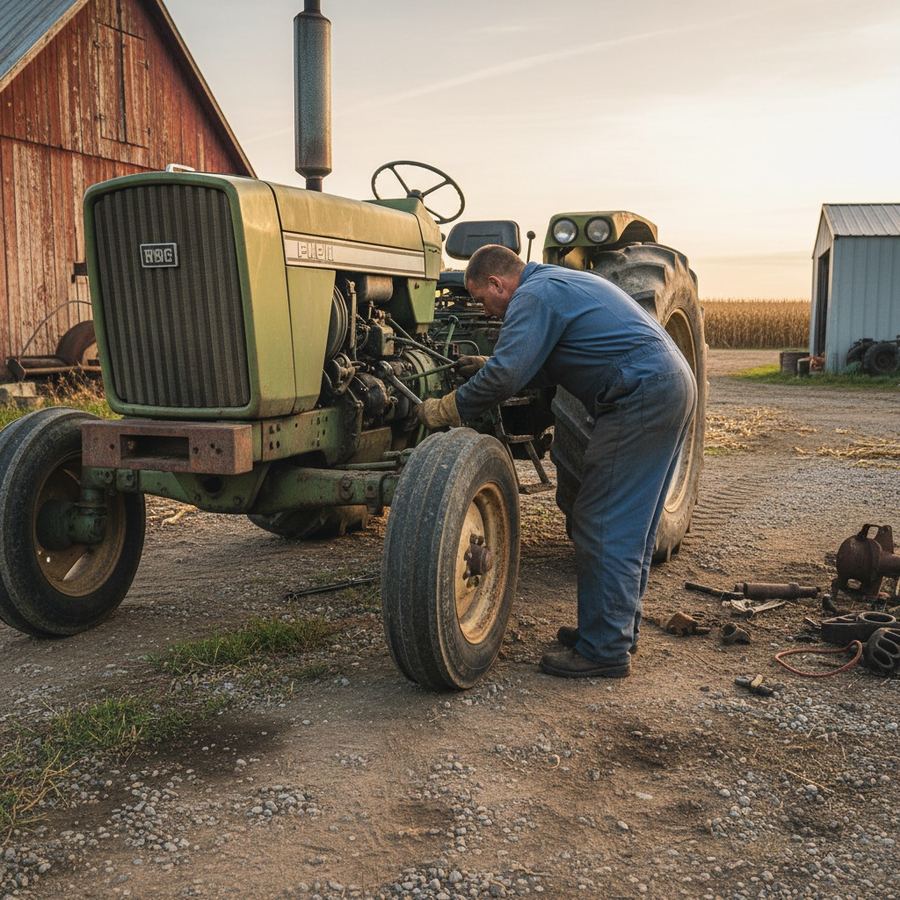
If you are shopping MFWD, the front end gets its own inspection. Jack the front end up and grab a front tire at 12 and 6 o'clock. More than a quarter inch of in-out play means king pin bushings are worn. Grab at 3 and 9 and rock it. Play here means wheel bearings. Either one is a fix, but king pin work on some MFWD axles runs $600 to $1,400 in parts and a day of labor.
Look at the front hubs and the steering knuckles for oil seepage. A weepy seal is normal. A pool of gear oil at the bottom of the knuckle housing is a failed seal that has been leaking for a long time, and the hub bearings have probably been running on whatever is left. Check the condition of the drive shaft between the drop box and the front axle. It has U-joints that need grease, and on a neglected tractor those joints seize and break.
Engage the 4WD lever and drive the tractor in a slow figure eight on dry pavement. It should engage cleanly, crow-hop slightly through the turns (that is normal on MFWD because of the slight front overdrive), and disengage without grinding. If the 4WD will not engage, or will not disengage once engaged, the drop box clutch is worn or the shifter linkage is out of adjustment. Neither is cheap.
Specific Model Notes
Kubota L-series (L3200, L3301, L3901, L4701) MFWD front ends are generally durable. The common failure at high hours is the front axle pivot pin bushings wearing and allowing the axle to sag, which shows up as uneven front tire wear. Fix is a pivot pin and bushing service, parts under $300, labor another day.
JD 4020 was available in 2WD and in an MFWD option that is now rare. The 4020 MFWD trades at a significant premium over the 2WD version because so few were built. A 2WD 4020 is still a legitimately good tractor for flat-ground loader work if you can add rear ballast.
JD 4440 in MFWD is one of the better used buys in the 130 HP class for a small farm that needs real pulling power. The 4WD version typically runs $6,000 to $10,000 more than the 2WD but holds value well and tackles ground the 2WD cannot touch.
Massey Ferguson 135 is almost always 2WD and that is fine. The MF 135 is a 45 PTO horsepower utility tractor from the 1960s and early 1970s, it is light, and on dry ground or light hay work it gets the job done without a front drive. If you need traction at that HP class, look at an MF 1735M or similar newer compact.
Matching the Tractor to the Ground
Before you decide, walk your own property in March when the ground is softest and make an honest assessment. If you can drive a 2WD pickup truck on every part of your land year-round without chains, 2WD tractor is probably fine. If there are spots where you already know not to go without 4WD, pay the MFWD premium. Our guide on best used tractor sizes for acreage owners covers horsepower and weight sizing, which interacts with the drive question. And once you find a candidate, go through how to inspect a used tractor before buying and pay special attention to the front axle checks in tire condition and wheel issues on used farm equipment.