Bring a flashlight, a clean rag, a magnet, and about two hours. A proper used tractor inspection is not something you rush in the ten minutes before the owner wants to leave for supper. The order below is the one I use on everything from a tired Ford 8N sitting in a barn to a 1990s Case IH 7140 with 8,000 hours on the clock. Skip steps and you will overpay on something with a cracked block or a tired hydraulic pump that costs more than the tractor.
Start With a Cold Walk-Around
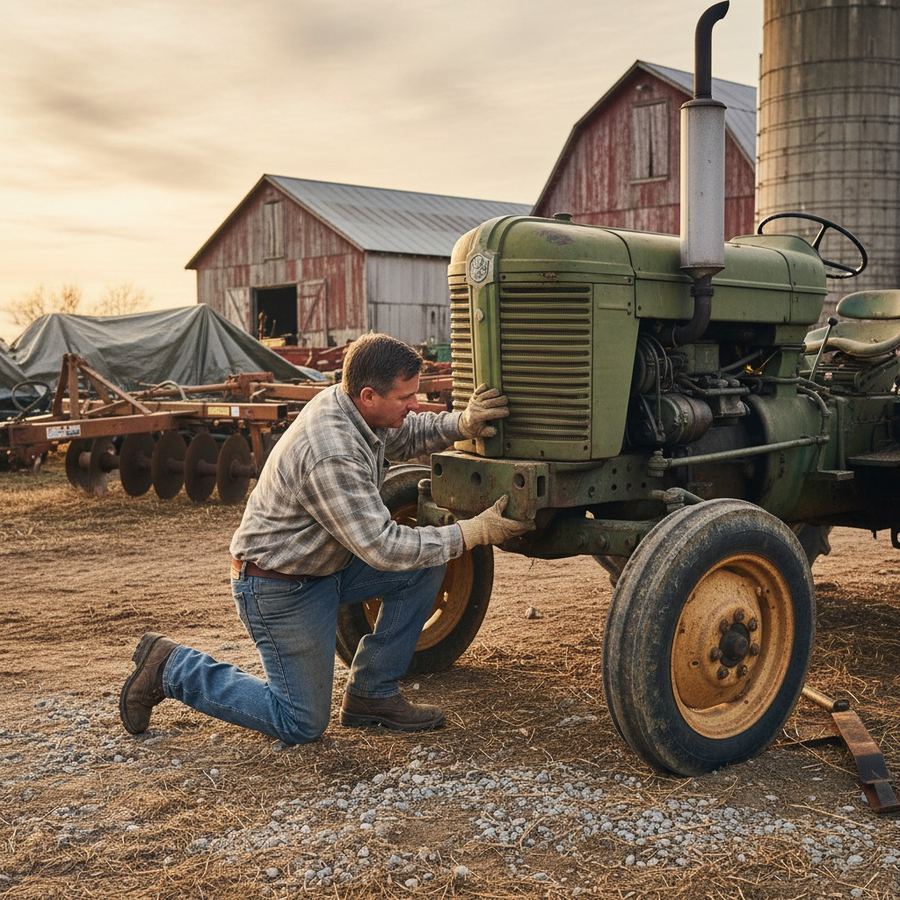
Before the seller starts it, walk the whole tractor. You want it cold. A warm engine hides head gasket weep, turbo oil leaks, and the telltale ticking of a failing injector. Look at the frame rails and the front pedestal casting for welds that do not belong. Factory welds are clean and consistent. A ground-and-repainted weld near the front pedestal on a loader tractor usually means the front end has been cracked and repaired, which is common on JD 4440s and IH 1066s that lived their life with a heavy loader and an operator who dropped bales too hard.
Check the sheet metal around the battery box and the fuel tank. Rust-through on a battery box is cosmetic. Rust-through on the transmission housing or the final drive casting is catastrophic. Look underneath with the flashlight. Fresh oil drips on the floor under a tractor that "just sat" are a red flag. So is a suspiciously clean underside on an old machine. Someone spraying the bottom with degreaser before a sale is hiding leaks.
Oil, Coolant, and Fluids Before Start-Up
Pull the engine dipstick. You are not looking for the level, you are looking at the oil itself. Clean honey-brown or dark-but-translucent is fine. Milky, foamy, or coffee-colored means coolant is getting into the oil, and that is a head gasket or a cracked head. On a Perkins 4-cylinder, a head job runs $1,200 to $2,200 in parts and machine work if the head is still good. If the block is cracked, walk away.
Pop the radiator cap on a cold engine. Rust-brown coolant that looks like tea is neglect but fixable. Oil film on top of the coolant is head gasket. White chalky buildup on the cap means it has not been serviced in a decade. Next, pull the transmission and hydraulic dipsticks if the tractor has separate reservoirs. Hydraulic fluid that smells burnt is a dying pump. Metal glitter in the fluid is a failing transmission.
Cold Start the Engine Yourself
Tell the seller you want to be the one turning the key, on a cold engine, with you watching the exhaust stack. Any seller who refuses this is hiding something. Good cold start: cranks 3 to 6 seconds, fires, settles to a steady idle, and the smoke from the stack clears within 30 seconds to a light haze or nothing at all.
Red flags: thick blue smoke that never clears means worn rings or valve guides and a rebuild you do not want to pay for. White smoke that smells sweet is coolant in a cylinder, usually head gasket. Black smoke at idle is fuel system, often an injector stuck open or a dirty air filter, which is cheap unless the injectors need replacement at $80 to $250 each. A clattering top end that quiets after 60 seconds is normal on older diesels with mechanical lifters. A deep knock from the bottom end that never goes away is a rod bearing, and that tractor is now a parts machine.
Transmission and Clutch
With the engine warm, run it through every gear with the tractor stationary, then drive it. On a gear-drive tractor like a JD 4020 or an Allis 7000-series, every gear should engage without grinding if you double-clutch correctly. A synchronized range that grinds hard is worn synchros or a weak clutch. On a Power Shift or hydrostatic, listen for clunks between ranges and feel for hesitation. Hydrostatic charge pumps get tired around 6,000 to 8,000 hours on mid-size utility tractors, and a charge pump rebuild can run $800 to $1,500.
Drop the clutch at low throttle in a higher gear. If the engine stalls, the clutch is gripping. If the tractor barely moves while the engine keeps running, the clutch is slipping and you are buying a split job. Splitting a tractor for a clutch is the labor bill that swallows most barn-find deals, often $1,500 to $3,500 depending on the model and whether the shop has to pull the cab.
Hydraulics and PTO
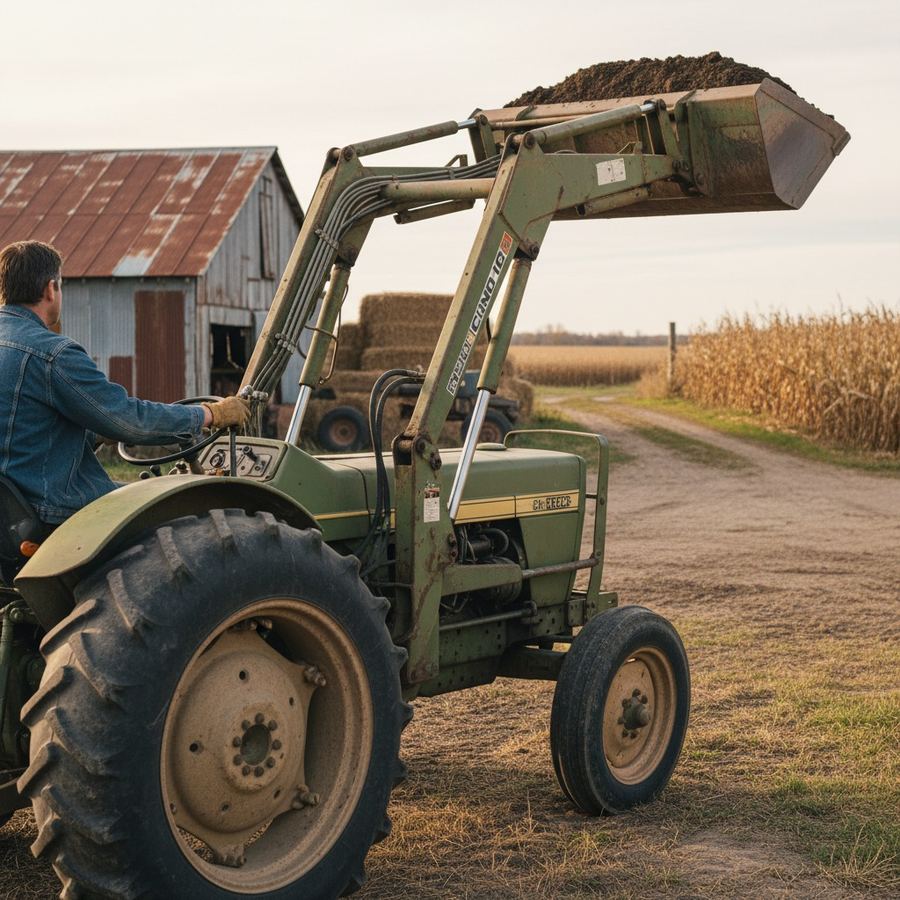
Hook up a loader bucket or a rear implement if one is available and cycle the hydraulics through full travel. The lift should be smooth, hold position without drifting, and not groan or shudder. Drift in the loader arms over 30 seconds with no load means worn cylinder seals, a leaking control valve, or both. Seal kits are cheap. A new control valve is not.
Engage the PTO at low idle first, then bring it up to rated speed. Listen for the shaft bearings and for any vibration. Run a PTO-driven implement if you can. A rotary cutter pulls enough load to expose a slipping PTO clutch. For much more detail on this, see our walkthrough on PTO clutch and transmission warning signs.
Brakes, Steering, and Tires
Independent brakes should bite evenly. On a JD 4440 or an MF 1100-series, one brake that grabs while the other does nothing is not unusual and usually means the weak side is seized or the pads are gone. A brake job is inside the final drive housing and is not a backyard afternoon on most of these. Steering should have minimal play. More than a quarter turn of slop at the wheel on a power-steering tractor means the steering valve or the cylinder seals are done.
Tires are one of the biggest hidden costs in a used tractor purchase. A set of four ag tires on a utility tractor is $2,000 to $4,000 installed. Cracks between the lugs on the sidewall are ozone rot and mean the tire is past its service life even if it holds air. Check the rims for rust-through, especially the front rims on a 2WD that had fluid ballast. We cover this in detail in tire condition and wheel issues on used farm equipment.
Electrical and Operator Station
Test every switch, every light, the horn, the dash gauges. A dead ammeter or a non-functional hour meter is worth negotiating over because it makes everything else suspect. Check the battery cables for green corrosion and the ground strap for tightness. A 12-volt conversion on a 6-volt-original tractor is fine if it was done cleanly, sloppy if the wires run across the exhaust manifold.
Finally, the seat and floorboards. A floor pan rotted through is a sign the tractor lived under a tree catching rainwater for years, and rainwater does not stop at the floor pan. It drips onto the transmission housing and finds every bolt hole.
When to Walk Away
Walk away from: milky oil, knocking bottom end, a cracked block or head, heavy metal in the hydraulic fluid, a transmission that jumps out of gear, or a seller who will not let you cold start it. Everything else has a price. Use the problems you find as a negotiating list, not a deal-killer. A tired Ford 5000 with good bones and worn hydraulics is still a useful tractor at the right number. For more on what else to watch for, our guide on common red flags in farm equipment listings covers what to spot before you even drive out to look. And if the machine is pre-1990, run through our specific checks for older diesel tractors before you hand over cash.