The used tractor market is not one market. It is at least four, and the buying logic in each is different enough that shopping a row crop tractor like you shop a compact utility will get you burned. This hub sorts the categories and links out to the detailed articles for each segment.
The main categories
Utility tractors are the broadest segment, roughly 40 to 110 horsepower, and they are what most small farms and acreage owners actually need. A Ford 5000, a Massey Ferguson 265, a John Deere 4020, a Kubota M7030: all utility tractors, all still working daily on thousands of farms. They run loaders, brush hogs, rotary cutters, and small implements. Decade ranges are wide. You can find a shed-kept 1970s utility for under six thousand dollars if you are patient, and a late-model off-lease unit for five times that.
Row crop tractors are the heavy hitters, generally 100 horsepower and up, built with high clearance and adjustable wheel spacing for working between crop rows. The John Deere 4440, Case IH 1066 (an IH holdover that ran forever), Massey Ferguson 1155, and later the JD 4440 and 4640 dominate the used row crop market from the 1970s and early 1980s. Higher hours are normal, and a 6,000 to 8,000 hour row crop tractor with honest maintenance records is often a better buy than a 3,500 hour barn queen of unknown history.
Compact and subcompact tractors, under roughly 40 horsepower, are dominated by Kubota, John Deere, and more recently Mahindra and LS. The used compact market is tight because these machines get bought new by hobby farmers, run 400 hours over fifteen years, and come to resale looking like new. Price per hour is ugly compared to a utility tractor, but for five acres of lawn and a loader it is often the right tool.
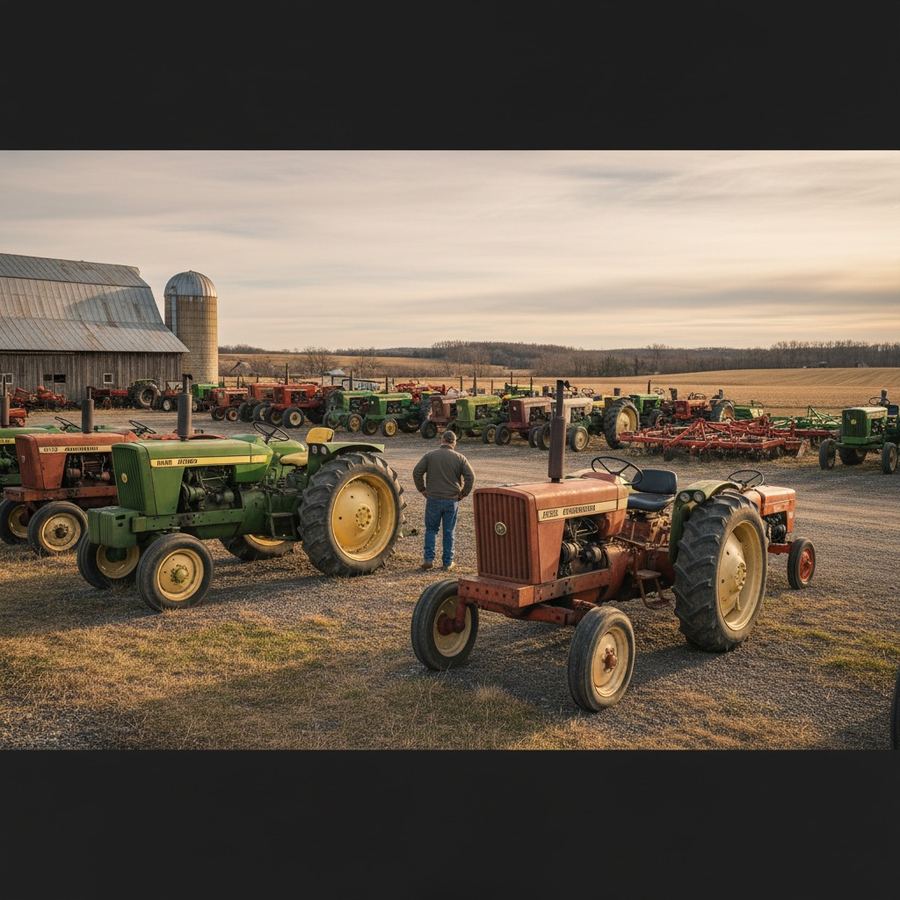
Hay tractors overlap with utility tractors in specification but get bought for a specific job: mowing, tedding, raking, and running a square or round baler. Buyers in this segment care about live PTO, creeper gears, and hydraulic capacity more than raw horsepower. A 90 horsepower Ford 7600 is a better baler tractor than a 110 horsepower tractor with marginal PTO clutch condition.
Browse by category
Used Row Crop Tractors
High horsepower field tractors. What to expect from JD, Case IH, and Massey Ferguson 70s-80s iron.
Used Utility Tractors
The 40 to 110 horsepower workhorses. Loader considerations and common gearbox issues.
Used Hay Equipment
Mowers, rakes, tedders, and balers. Includes notes on matching tractors to implements.
Used Tillage Equipment
Plows, discs, chisels, and field cultivators. What older tillage iron is worth.
Used Loaders & Attachments
Front-end loaders, buckets, grapples, and quick-attach systems.
Used Seed Drills & Planters
Grain drills, row planters, and older no-till rigs. Metering and opener wear.
Buying considerations
Before you go look at anything, settle what the tractor needs to do. A 60 horsepower utility does not pull a six-bottom plow. A row crop tractor does not fit through a pole barn door. A compact tractor with R4 industrial tires will tear up a pasture. Matching machine to job sounds obvious, but it is the most common mistake first-time buyers make, and it is usually driven by price rather than need.
Once you have narrowed the segment, inspection becomes the entire game. Our guide on how to inspect a used tractor before buying walks through the engine, hydraulics, PTO, and transmission checks in the order they should be done, including the cold-start observation that catches more problems than any other single test.
Hour meters are not lies, but they are also not the full story. An 8,000 hour John Deere 4440 with documented top-end work at 6,000 hours is a known quantity. A 2,800 hour Oliver 1855 that sat uncovered for fifteen years is an unknown quantity with fewer hours on the clock. Our piece on what hours actually matter covers the decade-and-brand context that hour counts need to be read through.
If the tractor is a 1970s or 1980s diesel, and most of the good used iron is, the diesel-specific checks in what to check on older diesel tractors are mandatory before writing a check. Injector pump failures, worn injectors, and tired head gaskets are repairable, but the repair cost needs to come off the purchase price, not added to it after the fact.