Buying a used tractor is only the beginning of the relationship. Keeping it running is the long marriage. The parts and maintenance side of used farm equipment is where most owners either get comfortable with the machine or get frustrated and sell it. This section covers the realities of maintaining older tractors and implements, including one counterintuitive truth: parts for a 50 year old tractor are often easier to find than parts for a 15 year old one.
The parts availability curve
A 1972 Ford 4000 has better parts support in 2026 than a 2010 mid-range utility with a proprietary electronic system that the manufacturer stopped building chips for. The reason is aftermarket. Tractors from the 1950s through the late 1980s were built in large enough volumes, with simple enough mechanicals, that a deep aftermarket industry grew up to support them. Rebuild kits for a Ford 8N, steering parts for a Farmall M, water pumps for an Allis-Chalmers WD, brake components for a John Deere 4020: all readily available, often from multiple suppliers, often for less money than the equivalent part on a newer tractor.
By contrast, a 15 year old tractor with a transmission control module that has gone out of production lives in the worst part of the curve. Too old for the dealer to stock. Too new for the aftermarket to have tooled up for. Too electronically dependent for a workaround. We mention this because buyers shopping between a well-kept 1985 MF 275 and a rough 2008 compact with warning lights sometimes miss that the 1985 tractor is genuinely easier to own.
Where parts actually come from
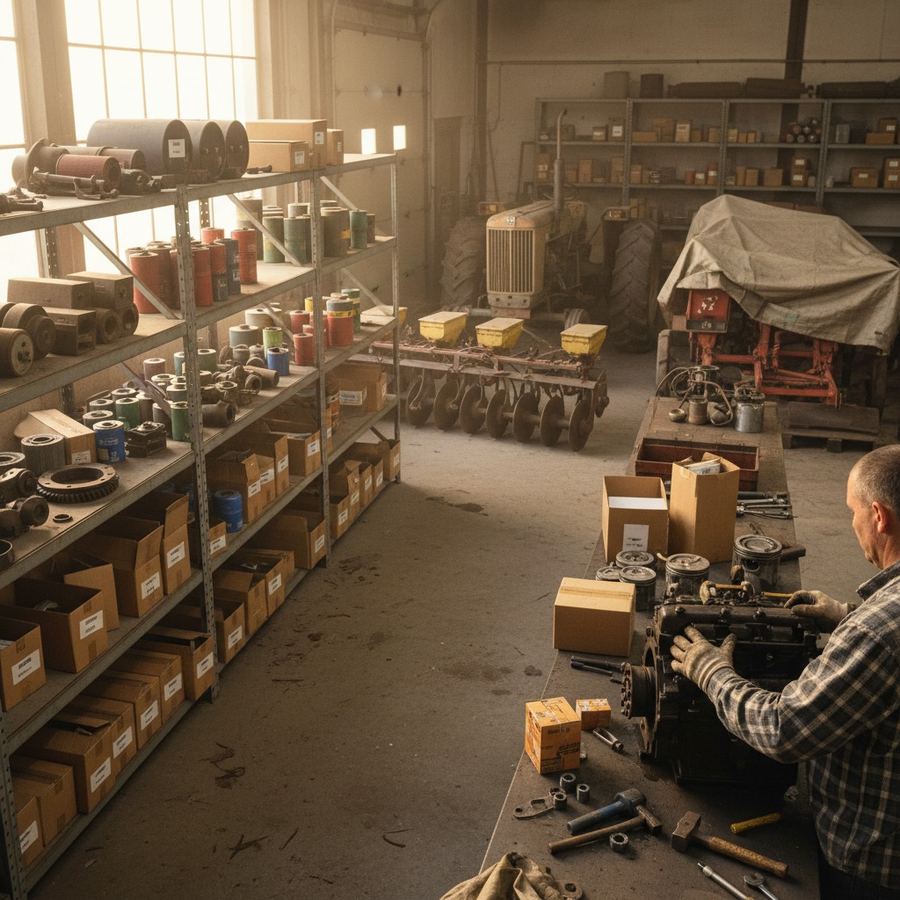
For legacy tractors, buyers typically pull from a handful of sources: OEM dealers for specific parts that only the manufacturer still makes, independent parts houses like TractorJoe or Steiner Tractor for vintage iron, Yesterday's Tractors and similar sites for rarer components and NOS pieces, aftermarket rebuilders for hydraulic pumps and injector pumps, and the local bearing and hydraulic shop for anything generic. None of these are endorsements. They are just the names that come up when experienced owners talk about where they source parts.
For implements, the picture is similar but often simpler. Wear parts (disc blades, plow shares, baler belts, rake teeth) are commodities. Bearings are commodities. Hydraulic cylinders can usually be rebuilt locally. The weird parts are brand-specific gearbox components and electronic monitors on planters, and those are where the hunt starts.
The articles
Maintenance Basics for Older Machines
Fluids, filters, greasing schedules, and the short list of things to do every spring and fall.
Finding Parts for Legacy Models
Where to look for parts on tractors from the 50s through the 80s, and what to expect on pricing.
Hydraulic Problems
Leak-down tests, soft cylinders, slow lift, and what it costs to chase a pressure problem.
PTO, Clutch & Transmission Signs
Noises, slippage, and engagement issues that signal real work ahead.
Tire & Wheel Condition
Sidewall cracks, hub wear, and when a reseal is worth doing on implement wheels.
What maintenance actually looks like
Ownership cost on an older tractor is not evenly distributed. Most years, it is filters, oil, grease, a set of batteries every four or five years, and a tire occasionally. Then one year it is a front axle bearing, a hydraulic pump rebuild, and a clutch job, and that year ruins the spreadsheet. Experienced owners budget for this by assuming one major repair every three to five years of hard use, on top of routine consumables.
The routine consumables are the part new owners tend to skip, and it costs them. Hydraulic fluid on a tractor that does loader work should not go eight years. A rear-end oil change on a utility tractor is cheap insurance against a thousand dollar repair. Fuel filters are a dollar item that prevents injector pump work that runs four figures. None of this is exotic maintenance, but it has to actually happen.
Our article on maintenance basics for older machines lays out a simple seasonal schedule, and the piece on finding parts for legacy models covers the sourcing side of keeping those schedules realistic. The other three guides focus on the diagnostic side: hydraulics, drivetrain, and running gear. Between them, they cover the majority of the repair decisions a used tractor owner will actually face.