A small square baler that kicks out a clean 40 pound bale is worth its weight in beef prices, and a round baler that wraps tight on the first try will save you more in lost hay than most tractors will earn you in a season. Hay equipment is where small operations feel the most margin pressure, because the window to get hay up is short, the weather is never on your side, and a broken baler in the middle of a Saturday cutting is an expensive problem. Buying used hay tools well means understanding what wears out, what is cheap to fix, and what will leave you standing in a field with a tangle of twine at three in the afternoon.
The four jobs of hay equipment
Every hay operation does four things in sequence: cut, condition, rake, bale. Some machines combine steps. A mower-conditioner cuts and conditions in one pass. A tedder flips the windrow to speed drying and is optional on some operations and essential on others depending on humidity. A rake gathers the dry hay back into a windrow the baler can pick up. The baler compresses it into either small squares, large squares, or round bales.
For most small to mid-sized farms running 20 to 300 acres of hay, the practical setup is a 7 to 9 foot mower-conditioner, a rotary or wheel rake, and either a small square baler or a 4 by 5 round baler depending on the market and the labor situation. Tedders are common in wetter climates and optional in dry ones. Getting this lineup together used typically runs $15,000 to $40,000 total depending on the age and condition of each piece.
Round balers
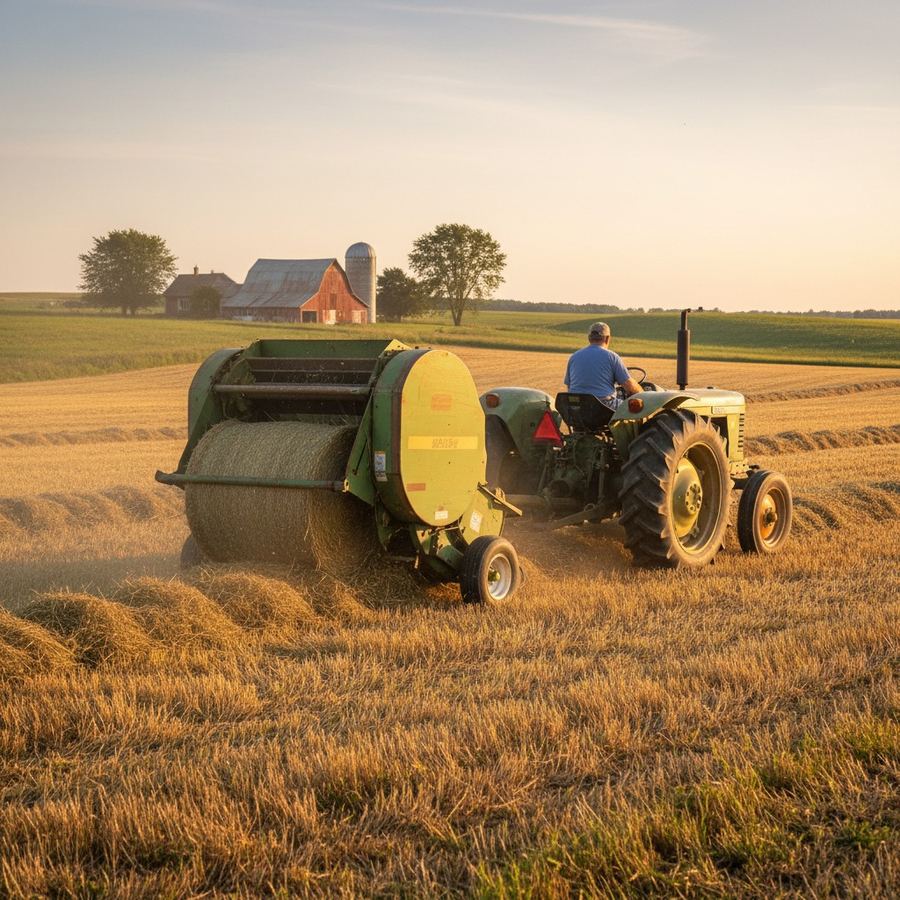
The John Deere 535 is probably the most common used round baler in the country. Built from 1988 to 1995, it makes a 5 by 6 bale with belt and roller design that is forgiving, reliable, and cheap to repair. Belts are the main wear item and a full belt set runs about $1,500 to $2,200. Rollers and bearings are the second wear item. A 535 with good belts, a working monitor, and no frame cracks sells for $4,500 to $8,500. The 566 and 567 that followed are more refined versions of the same basic design and sell for $8,000 to $16,000 depending on condition and options like net wrap.
New Holland BR740, BR750, and BR7060 are the Deere's main competition. The New Holland roll-belt design is excellent, bale shape is consistent, and the hydraulic circuit is simpler than some competitors. NH BR-series balers with net wrap bring $9,000 to $18,000 in clean condition.
Vermeer 504 and 605 series round balers are the other name to know. The 504 is a belt-drive 4 by 5 or 5 by 5 machine that shows up everywhere, and the 605 is the bigger brother that made huge numbers of 5 by 6 bales on commercial hay operations through the 90s and 2000s. Vermeer balers have a devoted following among guys who run them because parts support is strong and the design is straightforward. Used prices track the Deere and New Holland offerings closely. Krone and Case IH round balers are less common but well regarded when you find them.
Round baler inspection is about belts, bearings, and bale shape. Run the baler empty if you can. Listen for bearing noise in the rollers and check the pickup tines for bent or missing teeth. Look at the bale shape on bales the seller has already made if they are sitting in the field. A consistent cylinder shape means the baler is tracking straight. A barrel or cone shape means the belts are worn unevenly or the tensioner arms are not working right. Check the monitor if it has one. A baler that does not report bale diameter is just a guess machine.
Small square balers
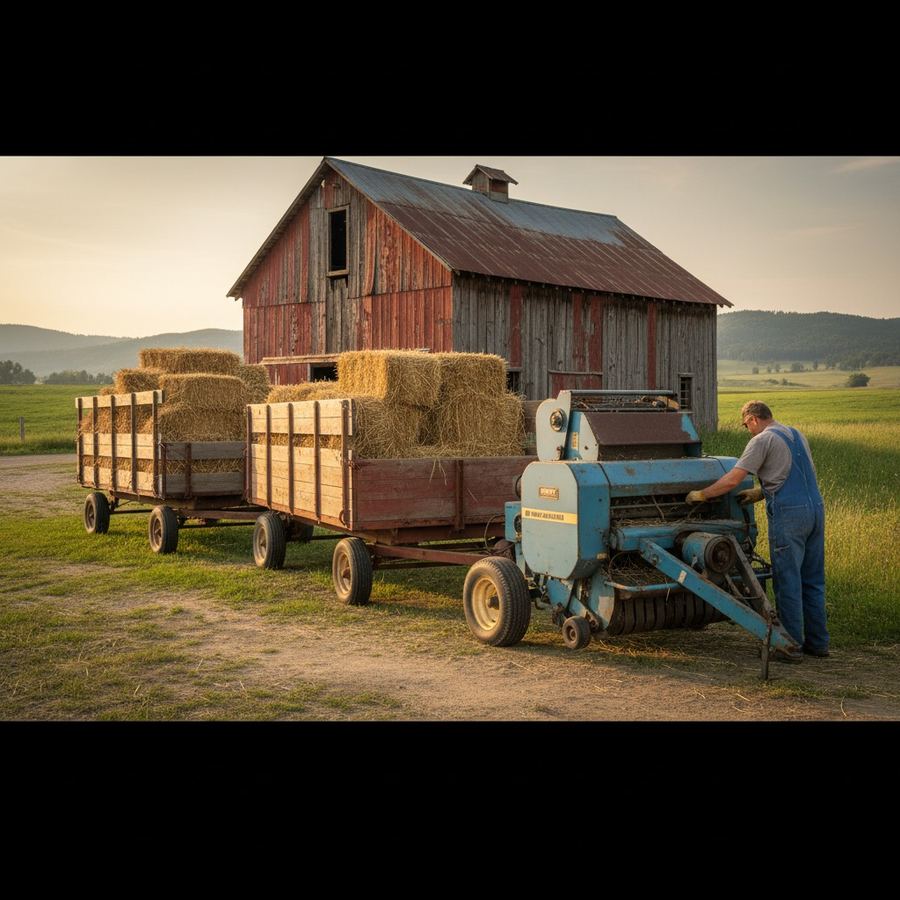
Small square balers are a different animal. They are mechanically complex, they have specific things that wear out, and they are judged on one thing: whether the knotters work. A small square that drops a half-tied bale every fourth stroke is a small square that is going back on the trailer.
The New Holland 273, 275, 276, 310, and later 565, 570, 575 are the most common small squares in the market. The Massey Ferguson 124 is another very common name. The John Deere 14T is a heritage machine that predates most of what is on used lots today but still shows up at estate sales. The JD 348 and 338 are the later John Deere versions that compete directly with the New Holland 570 family, and they are some of the best small square balers ever built. A clean 348 with under 20,000 bales through it runs $12,000 to $22,000.
Bale count matters more than hours on small squares. A baler that has made 50,000 bales has seen every knotter cycle, every plunger stroke, every pickup revolution fifty thousand times. Parts wear in predictable ways. Plunger bearings and the plunger safety device are primary wear items. Knotter cams and bill hooks wear from twine abrasion. The pickup tines bend and break. None of this is exotic, but replacing a full knotter assembly on a 273 is a $600 to $1,200 job and replacing plunger bearings is a half-day shop visit.
Ask the seller to run the baler and tie off a few bales with you standing next to it. If the twine is consistent, the bales are tight, and the knotters are not throwing twine tails, you are probably looking at a working machine. If the seller will not run it, that by itself is a red flag worth leaving for. The article on listing red flags has more on what to watch for.
Mower-conditioners, tedders, and rakes
The IH 990, JD 1207 and 1209, and John Deere 945 and 946 mower-conditioners are the machines most small operations will see on the used market. A haybine with sickle sections and a rubber roll conditioner is a traditional design and works well in grass hay. Disc mower-conditioners like the NH 1411 and the later JD 835 series cut faster and handle down crops better but cost more to own. Used haybines with straight frames and working PTO shafts run $2,500 to $6,500. Used disc MoCos run $6,000 to $18,000 depending on age and width.
Check the knife bar on a sickle mower. Bent guards, broken sections, and worn hold downs all translate into a rough cut and lots of maintenance. On disc mowers, check the cutterbar for bearing noise and look at the disc modules for damage. A disc mower that has hit a rock will have bent hubs that cost real money to fix.
Tedders and rakes are simpler. A wheel rake like the Sitrex or Vermeer WR series is a mechanical device with almost nothing to go wrong. A rotary rake has a gearbox and tines that can wear. A tedder is a set of rotors that flip hay, and used ones are usually inexpensive. Budget $1,500 to $4,000 for a good used rake and $2,500 to $6,000 for a tedder depending on working width.
Matching equipment to tractor
A round baler needs about 1 horsepower per foot of bale width plus 20 horsepower minimum for drive and pickup, meaning a 4 by 5 round baler needs a 45 horsepower tractor at an absolute floor and prefers 60 plus. A small square baler needs around 35 to 45 PTO horsepower for reliable operation. A 9 foot mower-conditioner wants 70 plus horsepower on rolling ground. If you are shopping for hay equipment and a tractor together, the piece on used utility tractors covers what size tractor matches what implement reasonably. The PTO is the failure point that will strand you in the field, so the writeup on PTO and transmission warning signs is worth a read before you hook anything to the tractor.
One last thing. The cheapest way to own hay equipment is to buy machines that the previous owner stored inside. Sunlight destroys belts, cracks plastic, and dries out twine tensioners. A baler that lived in a shed for twenty years will outlast a baler that lived in the weeds for five. Pay more for the one that was kept dry. It is always worth it.