A clutch job on a 4020 with a loader and duals, done by a shop that has to split the tractor, pay for the hoist time, and source a kit, runs north of $2,500 before anyone finds the pilot bearing is shot or the flywheel has heat cracks and needs to be resurfaced. That is the number you should have in your head when you are standing in front of a tractor wondering whether the pedal feels a little soft. Clutches, PTOs, and transmissions are the three most expensive drivetrain repairs on an older tractor, and they are also the three most hideable problems during a 20-minute test drive. Here is what to actually test for.
Single-Stage vs. Two-Stage Clutches
Older tractors come with one of two clutch arrangements. A single-stage clutch is one disc, one pedal, and when you press the pedal both the transmission and the PTO stop turning. Simple, durable, and found on most utility tractors through the 60s and 70s and on smaller compact tractors right up to the present. A two-stage clutch (sometimes called a dual-stage) is two discs stacked on one pedal. The first half of pedal travel disengages the transmission only. The second half disengages the PTO. This lets you stop forward motion without stopping a running baler or mower.
The catch with two-stage clutches is that they wear unevenly. The transmission disc usually goes first because drivers use it more. When the second-stage PTO disc wears, you get the worst symptom of all: the PTO will not disengage fully with the pedal on the floor, and you cannot safely approach a running implement. That is a walk-away for a buyer who does not have a shop at home. A two-stage clutch kit for a JD 4020, 4440, or similar runs $400 to $800 for the kit alone, plus the split.
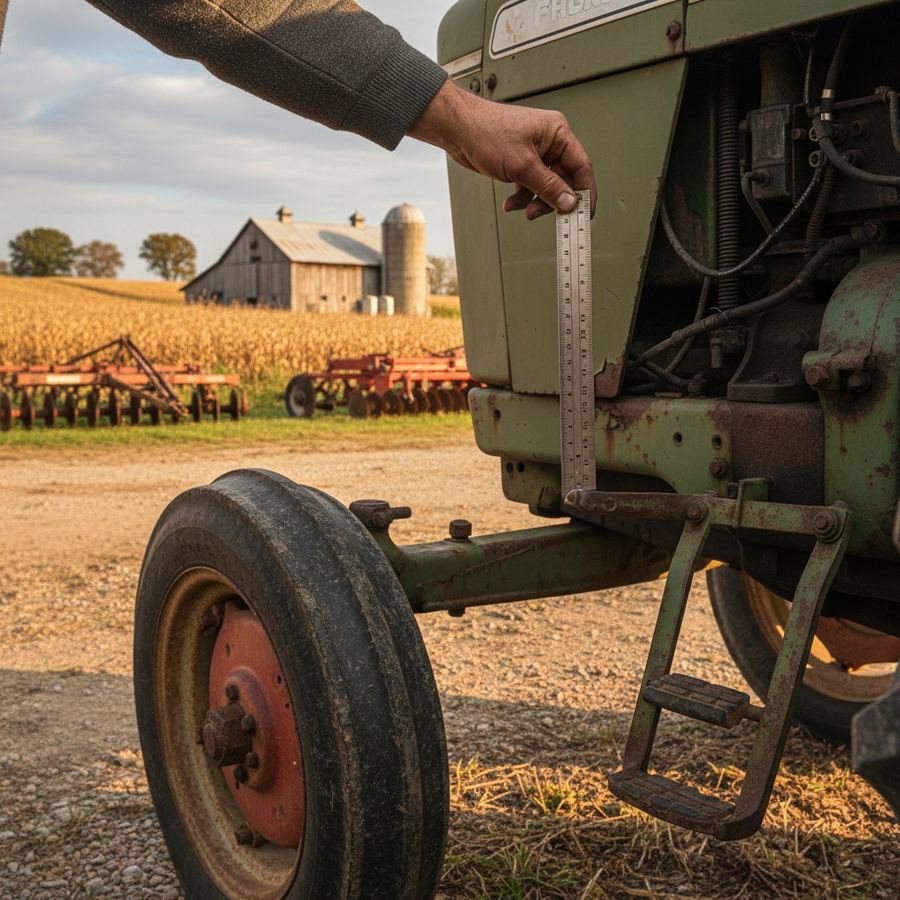
Slipping Clutch: The Under-Load Test
A slipping clutch rarely shows up in an empty test drive. It shows up under load. The classic test: engage the highest gear the tractor will safely pull on level ground, ease the clutch out against a load (a heavy disc harrow, a loaded wagon, or a set of brakes you hold while the tractor tries to move), and watch the tachometer versus ground speed. A clutch that is gone will let engine RPM climb without corresponding ground speed. A clutch that is still okay will either move the load or stall the engine.
Other symptoms: burning smell after heavy pulls (the facing material is glazing and slipping), pedal that has lost free travel (adjusted out to compensate for disc wear), grabby engagement (warped pressure plate or contaminated facings from a leaking rear main seal). Free travel spec varies by model but is usually 1 to 1.5 inches at the pedal. Zero free travel means someone has adjusted the linkage to the end of its range, and the clutch is close to done.
Clutch Noise: Chatter, Rumble, Squeal
With the tractor running in neutral, listen with the clutch engaged and with the clutch pressed. A high-pitched squeal with the pedal down that goes away when you lift it is a dry throwout bearing. Replace before it disintegrates and takes out the release fork and the pressure plate fingers. A low rumble with the clutch engaged that goes away with the pedal down is an input shaft bearing. That requires a split to fix and is significant money. A chatter on engagement is usually a warped disc, contaminated facings, or loose bellhousing bolts.
Live PTO vs. Independent PTO
Three PTO arrangements exist on older tractors and they test differently. Transmission PTO (early tractors, tied to the transmission clutch, stops when you press the clutch pedal) is simple and usually reliable. Live PTO (two-stage clutch, PTO keeps running when you stop the tractor but stops when you fully depress the pedal) is the two-stage clutch issue described above. Independent PTO (a separate clutch pack, usually hydraulically engaged, with its own lever) is the most complicated and the most failure-prone on high-hour tractors.
Test the PTO by engaging it at idle with no implement attached and watching for smooth engagement without clunking. Then raise RPM to 540 speed (usually around 1900-2100 engine RPM depending on the tractor) and check that the PTO stub spins smoothly without wobble. Pull on the stub by hand with the tractor off and the PTO disengaged; a badly worn output shaft bearing will show visible play. Engage and disengage under load if you can rig up an implement. An independent PTO that hesitates or slips to engage is telling you the hydraulic clutch pack is worn.
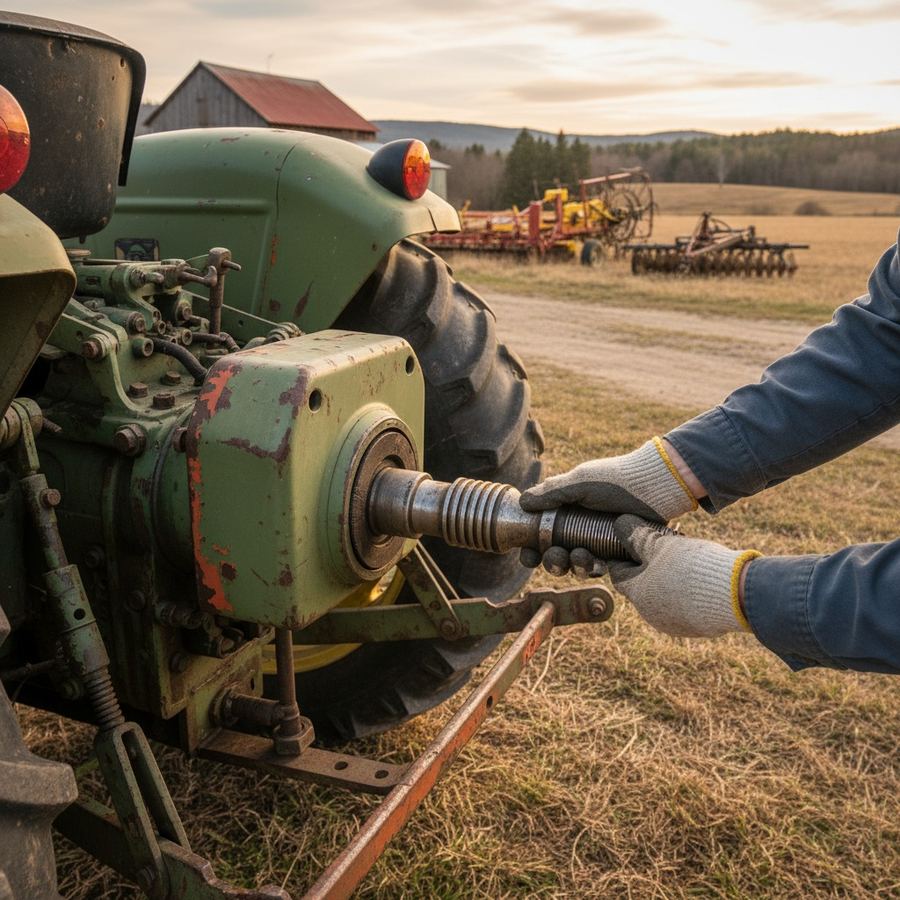
The JD Power-Shift PTO Problem
Certain JD models with hydraulically actuated independent PTOs (including the 4020 and some 4000-series) are famous for PTO clutch pack failures when the fluid has not been maintained, the wrong fluid has been used, or the operator has ridden the PTO engagement lever. Symptoms: PTO engages softly, slips under load, eventually will not drive the implement. Repair requires disassembling the rear end to replace the clutch pack. Budget $1,800 to $3,500 depending on shop rates and what else they find. This is one reason the hydraulic fluid on these machines matters so much; JD Hy-Gard or an approved equivalent is not optional.
Transmission: Jumping Out of Gear
Transmissions on older tractors die in characteristic ways. Jumping out of gear under load is the most common. Cause is either worn synchros (on synchromesh transmissions) or worn detent springs and detent balls that no longer hold the shift fork in position. Detent spring replacement is a few dollars and a few hours of work if you can get at it without splitting the tractor. Synchro replacement means a transmission rebuild and is four figures minimum.
Hard shifting when cold that eases up when warm is common on old gear transmissions and usually not a big problem, as long as it does not grind badly. Grinding into gear means the clutch is not fully releasing (clutch problem, not transmission problem) or the synchros are worn. Grinding out of gear on downshifts is a synchro problem.
Test every gear. Shift through every range. If the tractor has a range box or a high-low, test both. If it has a creeper, engage it. Test reverse. Listen for noise in each gear and note whether it changes with engagement of the clutch or the PTO.
Powershift vs. Gear: What You Are Buying Into
A powershift transmission (JD Quad-Range, IH 66/86 series, CaseIH 7100/7200) shifts between speeds under load using hydraulic clutch packs. When they work, they are fantastic. When they fail, you are looking at serious money. A powershift rebuild on a classic JD 4440 can run $4,000 to $8,000 at a shop. A sticky range shift, delayed engagement, or harsh shifts are warning signs that the clutch packs or the control valve are worn.
A straight gear transmission (Ford 4000, Massey 135, most older utility tractors) is cheaper to buy, cheaper to fix, and harder to break in the first place. A gear transmission rebuild is usually $1,200 to $2,500 for the whole job including bearings and synchros. If you are buying a first tractor and budget is tight, a gear transmission is the safer bet.
Range Box and Rear End Noises
A whine that changes pitch with ground speed but not with engine RPM is coming from the final drive, the differential, or the range box. A whine that changes with engine RPM is coming from the front of the transmission or the engine. A whine that appears only in certain gears is usually a worn gear or a bad bearing specific to that gear train.
Rear axle bearing whine (a low hum that rises with ground speed and is loudest around 10-15 mph equivalent) is common on high-hour tractors and is usually tolerable for years, but eventually the bearing fails and the axle has to come out. That is usually a $600 to $1,500 job depending on the tractor.
Pull the fill plug on the rear end housing if the seller will allow it. Oil should be clean (typical for UTTO fluid is reddish or amber) and free of metal. Metallic glitter on a magnetic drain plug is normal wear; metal flakes or chunks are not. A burnt smell from the rear end is usually a cooked clutch pack somewhere.
Putting It Together
Clutch, PTO, and transmission problems on older tractors are usually fixable, and the parts are available through the usual channels covered in where to find parts for legacy tractor models. What matters is knowing what you are buying into, pricing the repair realistically, and walking away if multiple systems are weak together. For the context around inspection order and hours-on-meter, see how to inspect a used tractor before buying and what hours matter on a used tractor. And if you spot hydraulic issues alongside drivetrain weakness, the hydraulic problems guide covers the related tests.