Before you ever drive to look at a used tractor or piece of farm equipment, the listing itself tells you a lot. A careful seller with a legitimate machine writes a detailed ad, takes honest photos, and answers direct questions. A seller hiding problems or running a scam follows a predictable playbook, and once you have seen it a few times you can filter out the junk without wasting a tank of fuel. Here is what to watch for on Craigslist, Facebook Marketplace, TractorHouse, Equipment Trader, and the auction platforms.
No Photos of It Running
The first filter. A listing for a $12,000 utility tractor that has eight still photos and zero engine-running shots (no video, no puff of exhaust at the stack, no close-up of the running gauges) is either lazy or hiding something. Ask directly for a video of a cold start. Note "cold start" specifically. A warm start video can hide smoke, hard starting, and low compression. If the seller cannot or will not send a 30 second cold start video, the tractor does not run well or it does not run at all.
Sellers sometimes send a video of the tractor at high idle, revving up and down, which looks impressive but tells you nothing. You want to see it cranking over cold, catching, and settling to a low idle for 20 seconds without stumbling.
Photos From Only One Side
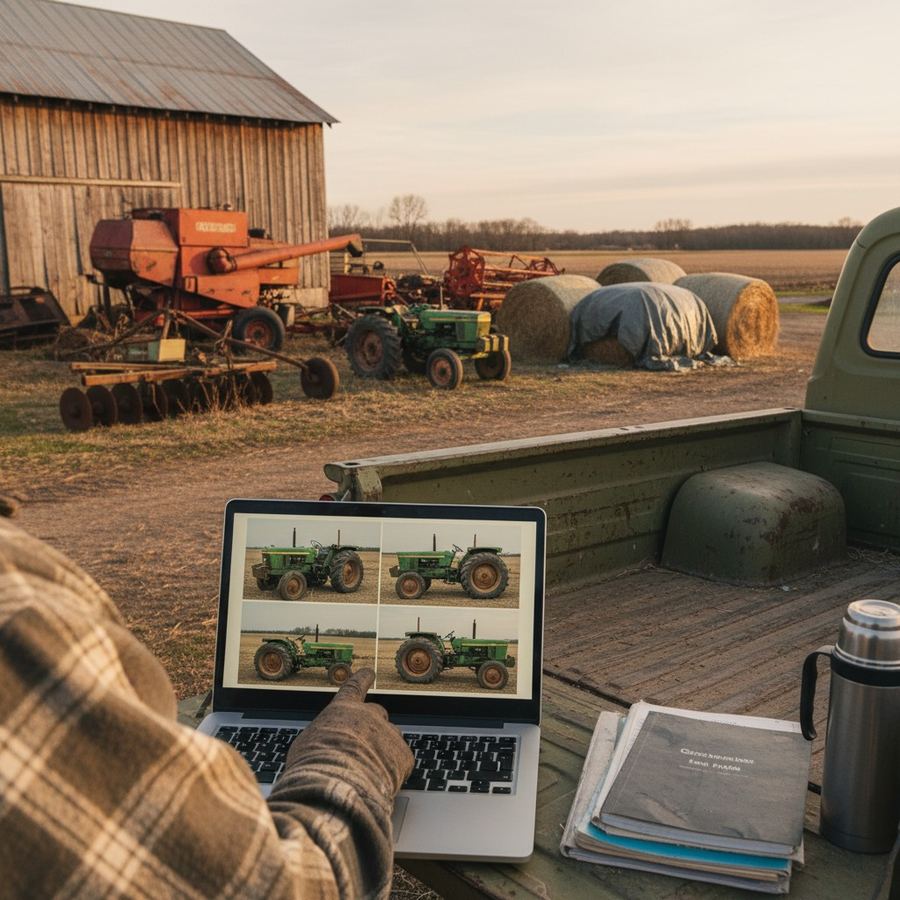
A complete listing shows: front three-quarter, rear three-quarter, both sides, the operator station, the engine bay, the hour meter, the tires, the loader if equipped, and the PTO and 3 point hitch area. If every photo is from the same angle, the seller is hiding the other side. Equipment that has been in a rollover, hit a tree, or had a fire usually looks fine from one side and obviously wrong from the other. A backhoe shown only from the boom side could have a rotted frame rail opposite.
"Runs and Drives" With No Other Detail
"Runs and drives. Selling as-is. Cash only. No tire kickers." This language is a specific signal. It means the seller does not want questions, does not want to disclose known problems, and wants the transaction done fast. A real seller with a real tractor writes at least a paragraph: what year, what hours on the meter, what condition the hydraulics are in, what recent service has been done, whether the PTO works, whether the loader leaks down, any known issues.
"Runs and drives" is technically true for a tractor that runs for 15 minutes before overheating and drives in first gear only because the rest of the gears grind. It is not a description, it is a legal hedge.
Fresh Paint Hiding Rust and Decals
A 1972 JD 4020 with what looks like factory-fresh green paint and correct yellow decals is suspicious. Not impossible (someone did a cosmetic restoration) but suspicious. The question is always what the paint is covering. Rust on the fenders, cracks in the sheet metal, welds on the frame, replaced castings from a parts tractor. Paint hides all of it.
Look at the corners, inside the wheel wells, under the platform, around the fuel tank straps. Honest paint is consistent across hard-to-reach spots. A sprayed-over tractor has paint on the hydraulic hoses, overspray on the wiring, paint in the bolt heads, and crisp new decals on a 50-year-old machine. The crisp decals are the giveaway. Original decals fade and crack. Nothing wrong with buying a repainted tractor if you know that is what you are getting. Wrong when the listing calls it "original condition" and prices it accordingly.
Hour Meter Not Visible
Missing hour meter photo on a listing asking real money is deliberate. The seller wants you to ask, because then they can tell you the hours over the phone and you cannot prove what they said later. Insist on a clear photo of the hour meter, ideally with the key on so the meter is illuminated on tractors with digital displays. If the meter shows "----" or is clearly non-functional, that is not automatically a deal breaker but it needs to be disclosed and priced in.
On older mechanical meters, a reading that does not match the visible wear is a flag. A tractor with a polished shift lever, a worn seat, and faded paint on the steering wheel that reads 800 hours has either had the meter replaced or rolled it. Our notes on what hours matter on a used tractor covers this in detail.
Pricing That Does Not Match the Market
A 2018 Kubota MX5400 with 600 hours listed for $14,000 when comparable machines are $28,000 to $35,000 is not a deal. It is one of three things: a scam, a stolen machine, or a tractor with a hidden catastrophic problem. Legitimate below-market listings exist (estate sales, owners who need cash fast, dealers unloading inventory) but they do not show up with an email-only seller and a vague location. They show up with a name, a phone number, a physical address, and a story that checks out.
Classic Craigslist scam template: attractive machine, below-market price, seller "just moved to Montana for work," wants to ship through a third-party escrow, asks for wire transfer or gift cards. The tractor does not exist and the photos were stolen from a real listing somewhere else. Reverse image search before you call. If the same photos show up on three listings in three states, it is a scam.
Refusing Video Calls or Follow-Up Questions
A real seller will walk around the tractor on a FaceTime or WhatsApp call, start it cold, show you the hour meter, let you hear it idle, cycle the hydraulics. Ten minutes and costs nothing. A seller who refuses is hiding something or is not actually in possession of the machine.
Same with follow-up questions. Ask specific things: does the PTO engage cleanly, any issues with the rear remote, when was the last oil change, does the loader leak down. A legitimate seller answers directly. A flipper or scammer gives vague non-answers. "Everything works good" is not an answer. "PTO engages clean, rear remote solid, changed hydraulic fluid last spring, loader drops maybe an inch in ten minutes under load" is an answer.
Title, Registration, and Paper Trail Evasion
Most farm tractors are not titled in most states, which is fine. If the seller gets evasive when you ask for a bill of sale, a serial number, or any documentation, back off. On skid steers, telehandlers, and compact track loaders, serial numbers matter more because these are common theft targets. Any seller who will not give you a serial number in advance is either hiding a stolen machine or does not know what they have.
"Too Clean" Auction Prep
The opposite problem. A tractor at an auction or a consignment lot that has been pressure-washed until the engine bay is spotless, with fresh paint on the wheels and tires that have been dressed with shine, is hiding oil leaks and corrosion. Honest used equipment shows honest dirt. A working tractor that has been run through a field recently has grass in the radiator screen, a film of dust on the engine, and tires with dry mud in the lugs. A tractor that looks like it spent the morning at a detailer has been prepped to sell, and the prep is there to hide problems.
This is especially true at auctions, where you have limited time to inspect. For more on navigating auctions versus dealer buying, see how farm equipment auctions differ from dealer purchases.
Platform-Specific Patterns
Craigslist: highest scam rate, lowest barrier to entry, best deals when legitimate. Insist on seeing the machine in person before any money changes hands. Never wire money, never use escrow services the seller recommends, never pay with gift cards. Meet at the seller's property so you know where the machine lives.
Facebook Marketplace: lower scam rate but not zero. Very new accounts with no friends and a single for-sale post are scam accounts. Real farmers on Facebook have years of visible history.
TractorHouse and Equipment Trader: mostly legitimate dealers and consignments. Scam rate is much lower but prices reflect that. For how to tell a good listing from a lazy one, see how dealers photograph and list equipment better.
The Questions That Filter Out Problems
Before you drive to look, ask these in a single message: Why are you selling? How long have you owned it? What were you using it for? What work has been done in the last two years? Can you send a cold start video and photos of the hour meter, tires, and hydraulic dipstick? Anything that does not work?
A seller who answers all of these directly is probably legitimate. One who sidesteps is wasting your time. For what to ask in person, see questions to ask a used equipment dealer. Once the listing passes the filter, run the candidate through our full used tractor inspection checklist.