The used utility tractor market is the biggest, busiest, and most forgiving segment of the whole used equipment world. A 1978 Ford 5000 with a loader and 6,200 hours is not a collector's item or a show piece. It is a chore tractor that still hauls a round bale, runs a 5 foot rotary cutter, and starts on the first turn of a cold morning if its previous owner was decent to it. For small farms, hobby ranches, acreage owners, and anybody with a pasture bigger than they can mow with a zero-turn, a utility tractor is the single most useful piece of iron you can buy.
What "utility" actually means
In manufacturer brochures, utility tractors run from about 35 PTO horsepower up to 90 PTO horsepower, with open station or low-profile cabs, standard or low center of gravity, and a factory loader option. In the used market the term is looser and usually means "not a compact, not a row crop, not a 4WD articulated beast." Call it the 40 to 90 PTO horsepower class. Below that, you are in compact territory: Kubota B and L series, JD 1 through 3 family, Mahindra Max series, that kind of thing. Above 90 and you are looking at mid-frame row crops or MFWD farm tractors that start to feel big for fence row work.
Weight is the better definition. A utility tractor is typically 4,500 to 9,500 pounds bare, which is heavy enough to pull a 5 foot tiller or 6 foot disk without skipping across the ground, and light enough to drive across a wet hay field without making ruts you will regret in July. If you are not sure whether you actually need this size, the article on sizing tractors for acreage walks through the math by acres and chore list.
The models you will see at every sale
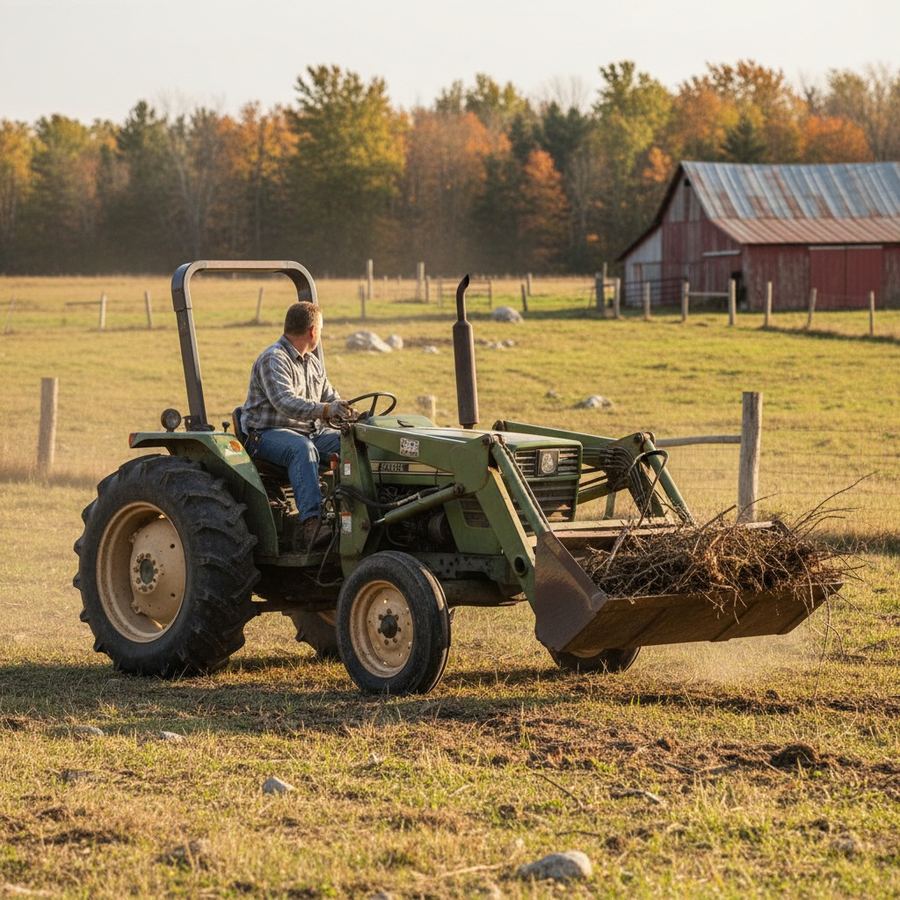
Ford's 3000, 4000, 5000 and later 3600, 4600, 5600 series are still the most common used utility tractors in the country. Built from the mid 60s through the early 80s, they came in gas and diesel, 2WD and later MFWD, open station and low-profile cab. A Ford 3000 diesel typically makes 38 PTO horsepower. A 5000 makes 55. A 7000 makes 75. They all share similar sheet metal, similar hydraulics, and an enormous parts aftermarket that makes them cheap to keep running. A clean 3000 or 4000 with straight tin and a working PTO runs $4,500 to $9,000. A 5000 with a loader, good rubber, and under 6,000 hours can hit $10,000 to $14,000.
Massey Ferguson 135 and 165 are the other pair you will see at every estate auction. The 135 makes 37 PTO horsepower from a Perkins 152 or AD3.152 diesel and is genuinely one of the best small utility tractors ever built. A 165 makes about 54. Both have the Multi-Power transmission, which is a split-range arrangement that works beautifully when it is healthy and is expensive to rebuild when it is not. Always check Multi-Power engagement in both ranges under load. A 135 with a tired Multi-Power will sell for $3,500 to $5,500. One with a clean transmission, working lift, and straight sheet metal brings $6,500 to $9,500.
John Deere's 2240, 2440, 2640, and later 2755 and 2950 are the Deere answer to this segment. A 2640 makes about 70 PTO horsepower and is widely considered one of the best chore tractors Deere ever built. The Syncro-Range transmission is simple, the 276 cubic inch diesel is long lived, and the fit and finish was good for its era. A 2640 with a factory cab and 158 loader regularly brings $14,000 to $22,000. Without the loader, subtract $4,000 to $6,000.
Kubota's L and M series came later but have earned a strong used reputation. An M5030, M6030, or M7030 from the 90s is a tough machine with a clean Kubota diesel and a simple shuttle transmission. Kubotas tend to hold value better than the old Ford and Massey fleet because buyers who want a reliable chore tractor and do not want to turn wrenches often end up at the Kubota lot. New Holland's TC and TS series from the late 90s and early 2000s are also strong buys when you can find them with low hours and a working front axle.
The loader question
This is the single biggest decision in the utility tractor market. You will see three common configurations: factory loader (installed at the dealer when the tractor was new), aftermarket loader that has been on the tractor for years, and no loader at all. Each has tradeoffs.
A factory loader is almost always the best setup. Brackets fit correctly, the hydraulic plumbing is clean, and the loader was matched to the tractor's weight and hydraulic capacity. JD 158, 148, 175, and later 640 loaders on Deere tractors, Ford 7209 or 7412 on Fords, and factory Massey 236 loaders all fall into this bucket. They add $3,000 to $6,000 to the price of the tractor compared to an identical bare machine.
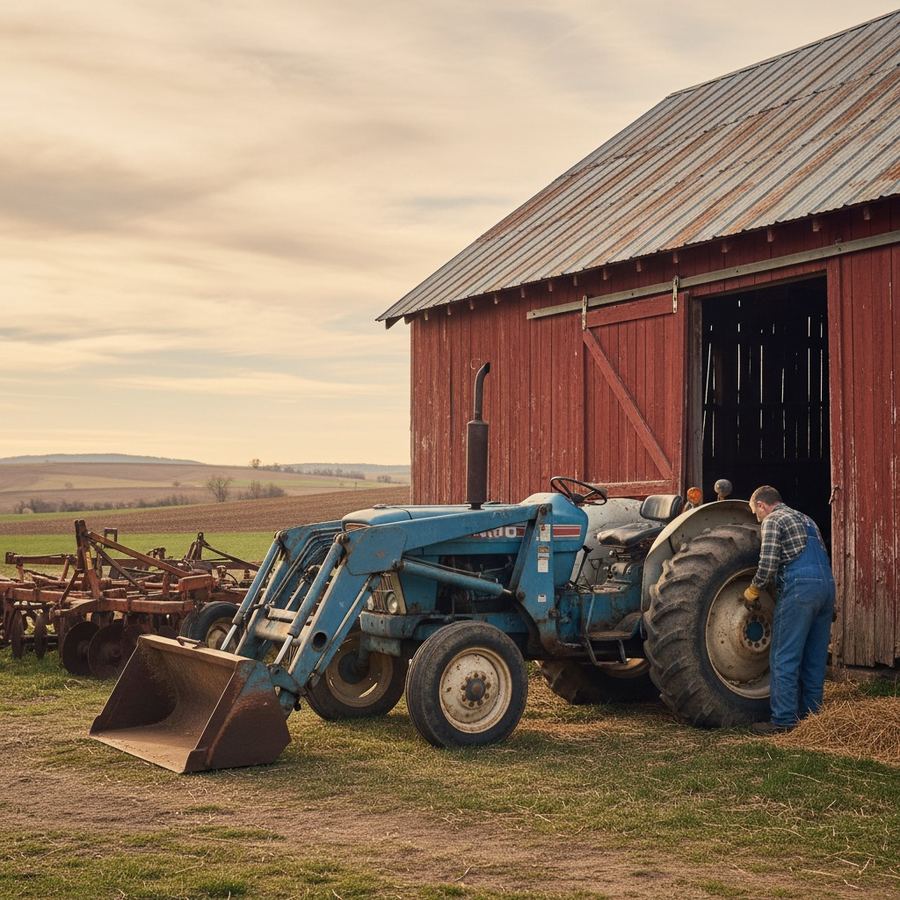
Aftermarket loaders from Bush Hog, Westendorf, Koyker, Allied, and Quicke are often very good quality, and in some cases better built than factory loaders. A Westendorf TA28 on a Ford 5000 is a workhorse combination. The risk is fitment. Brackets that were cut, welded, and drilled in somebody's shop twenty years ago may not align anymore, the hydraulic lines may be a mess of fittings and T blocks, and the mounting may put load where the tractor frame was not designed to take it. Crawl under the tractor and look at the loader subframe. If the mounting plates are bent, cracked, or the bolts are pulled through enlarged holes, walk away.
No loader at all is fine if you genuinely do not need one, and it is fine if you are willing to add a loader later at a cost of $3,500 to $7,000 installed. But for 90 percent of buyers in this segment, a tractor without a loader is a tractor that will spend half its time in the shed while you borrow your neighbor's.
What to inspect specifically on utility tractors
Utility tractors get used harder per hour than row crops. Six thousand hours on a Ford 5000 that spent its life pushing manure, pulling round bales, and mowing pastures is often rougher than ten thousand hours on a 4440 that ran a disk and a planter. Hours matter less here. Condition matters more. The general framework in the pre-purchase inspection guide applies, with a few category-specific additions.
Check the front axle carefully. On 2WD utility tractors, the front axle takes all the loader weight and wears out kingpins and tie rod ends. On MFWD utility tractors, the front axle is a gearbox and it can leak, have chipped teeth, or have bearing failure at the planetary hubs. Grab the front wheels top and bottom and rock them. Any meaningful movement means bearings or kingpins need attention.
Check the hydraulic capacity against the work you intend to do. A Ford 3000 has about 6 to 7 gpm at the rockshaft and can barely run a loader fast enough to be pleasant. A Kubota M7030 has 12 to 14 gpm and feels like a different tractor entirely. If you plan to run a rear tiller, grapple bucket, or any ground-engaging implement with hydraulic cylinders, pay attention to pump output before you buy. The hydraulic troubleshooting guide goes deeper on this.
Pull the PTO cover and look at the PTO stub shaft splines. Rounded splines mean a worn PTO, usually from running equipment without a slip clutch or from dragging the PTO under heavy load. A rounded stub is a $400 to $800 part plus labor.
Why utility tractors hold value
The utility tractor segment has the strongest resale floor in the used market for three reasons. First, there are always new buyers. Every year somebody retires, buys 20 acres, and decides they need a tractor with a loader. Second, the supply of good older machines is slowly shrinking as tired ones get parted out. Third, the new replacement cost is punishing. A new 55 horsepower utility tractor with a loader is $45,000 to $65,000 depending on brand and options. A clean 1985 vintage Ford 5610 with a loader for $14,000 looks very reasonable by comparison, and it will do the same work for another twenty years with basic maintenance.
The tradeoff is that you will not find screaming deals here. Good utility tractors are priced by people who know what they are worth. The buyers who do best in this segment are the ones who look for honest wear on well-kept machines and avoid the temptation of the cheap outlier with the fresh paint job.