Half of what you do with a utility tractor happens on the front end. Round bales, dirt piles, manure, firewood, gravel, fence posts, dead livestock, the snow the county plow pushed into your driveway. The loader is the reason the tractor stays hooked up instead of sitting in the shed, and the attachments hanging off the front are the reason a $12,000 tractor becomes a $20,000 machine that actually earns its keep. Buying a used loader and the right attachments is a separate problem from buying the tractor itself, and it rewards patience.
Factory loaders versus aftermarket
The first fork in the road is whether the loader was installed at the tractor factory or added later by a dealer or owner. Factory loaders are built for a specific tractor model, have engineered mounting brackets, and integrate with the tractor's hydraulic system through proper ports. John Deere's 158, 148, 175, 245, 265, and later 640 loaders are factory units. New Holland's 7411 and 7412 are factory NH. Kubota LA series loaders are Kubota factory. Massey Ferguson 236 and 246 loaders are Massey factory.
A factory loader almost always fits the tractor better, lifts what the spec sheet says it lifts, and does not put loads in the wrong places on the frame. Resale is better because the buyer knows exactly what they are getting. The downside is availability. If you buy a tractor that never had a factory loader, finding one later is expensive and sometimes impossible.
Aftermarket loaders are built by dedicated loader manufacturers who sell mounting kits for hundreds of tractor models. Westendorf, Bush Hog, Koyker, Allied, Quicke, Buhler, and Great Bend are the names you see most often in North America. Westendorf TA28 and TA46 loaders are common on Ford and Massey utility tractors. Bush Hog 2845, 2846, and 3545 loaders show up on Kubota and Deere compacts and utilities. Quicke loaders from Sweden have a following on European tractors and increasingly on North American ones.
The quality range on aftermarket is wider. A Westendorf or Quicke is often better built than any factory unit. A no-name Chinese loader on a mid-2000s import might have questionable steel and welds. Look at where the loader came from before you judge it by the brand on the frame.

Attachment standards
Attachments connect to the loader through a coupler. In the used market you will see four main standards.
The Skid Steer Universal coupler (also called Universal Quick Attach or SSU) is the most common attachment standard in North America. Almost any skid steer attachment fits almost any skid steer, and tractor loaders increasingly come with this coupler or can be adapted to it. If your loader has SSU, the attachment world opens up considerably: buckets, forks, grapples, augers, brooms, snow blowers, bale spears, rock buckets, and every other imaginable tool is available new and used in SSU fitment.
The Euro or Global hitch is the standard on most European loaders and many higher-end aftermarket loaders in North America. Attachments are plentiful and well designed but a smaller used inventory exists here than in SSU.
The John Deere 200, 300, and 400 series loaders have their own attachment standard. A 200 series attachment fits JD 200 series loaders, a 300 series fits 300, and so on. The good news is that Deere made a lot of 200 and 300 series attachments, so used inventory is deep. The bad news is that mixing and matching between series requires an adapter plate.
Pin-on attachments are the old standard. The bucket pins directly to the loader arms without a coupler. This is the cheapest setup and the most frustrating. Swapping a pin-on bucket for a pin-on pallet fork is a half-hour job with a hammer and a come-along. If your loader is pin-on and you plan to swap attachments regularly, consider adding a quick-attach plate. It is a $300 to $700 upgrade that saves hundreds of hours over the life of the loader.
Buckets, grapples, forks, and the rest
A general-purpose bucket is what comes on most used loaders. It has a straight cutting edge and no teeth and is suitable for dirt, gravel, snow, and manure. A material bucket is wider and deeper for light material like mulch or snow. A tooth bucket has replaceable teeth bolted or welded to the cutting edge and is used for digging in hard ground and rocky soil. A tooth bar clamp kit lets you convert a smooth bucket to a toothed one for $150 to $400.
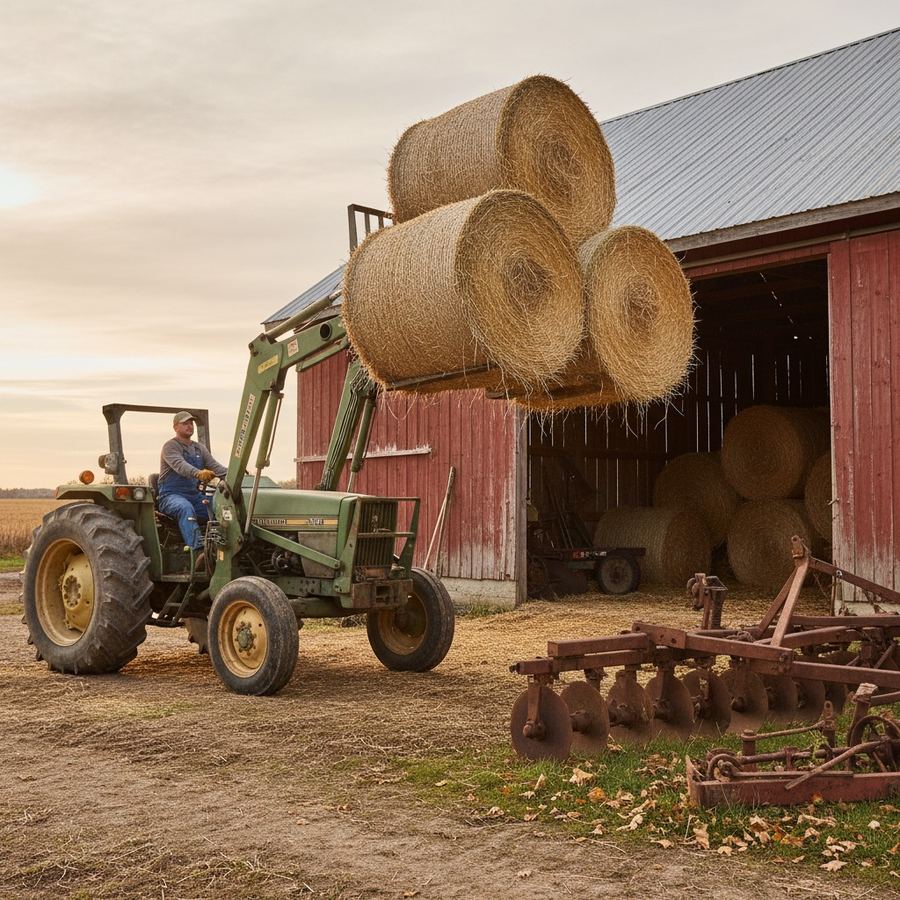
Pallet forks turn a loader into a rough-terrain forklift. A set of 48 inch pallet forks on a SSU mounting plate runs $400 to $900 used and is one of the best value attachments you can buy. Bale spears do one thing: pick up round bales. A single-tine bale spear runs $150 to $300 used. A dual-tine spear for heavy bales is $250 to $500.
Grapples are the attachment that makes a tractor feel transformed. A root grapple (sometimes called a brush grapple) has an upper clamp with teeth that grips brush, limbs, root balls, and loose material the bucket cannot hold. A clam bucket is a bucket with a closing upper jaw. Used grapples run $600 to $2,000 depending on width, build quality, and brand. They require a third hydraulic function on the loader, which is a separate topic.
Snow buckets are oversized buckets designed for pushing snow in volume. Pushers and pullers are specialized snow tools. For most small operations, a wider general-purpose bucket handles snow fine and does not need a dedicated tool.
Mounting, capacity, and counterweight
Loaders bolt to the tractor either with a subframe that runs along the sides of the tractor frame to a rear mounting point, or with straddle mounts that clamp to the axle housings. Subframes are stronger because they distribute load across the length of the tractor. Straddle mounts are simpler and cheaper but put concentrated stress on the front axle housing, which on older tractors can crack over time. Crawl under any used loader-equipped tractor and look at the subframe or mounting plates for cracks, weld repairs, and bolt holes that have been enlarged. These are the signs of an overloaded loader on an undersized tractor. The inspection guide walks through what to look at on the loader itself.
Hydraulic capacity determines how fast the loader lifts and what it can lift. A small loader on a 40 horsepower tractor with 6 gpm is painfully slow with a full bucket. A loader on a 75 horsepower tractor with 12 gpm feels responsive. The spec sheet will tell you maximum lift capacity at the pin and at full height, but real-world lift is always less, especially with a bale spear extending the load forward.
Counterweight matters. A tractor doing serious loader work should have rear ballast: wheel weights, fluid-filled rear tires, a rear implement on the three-point, or a dedicated ballast box. A tractor lifting a heavy round bale on the front without counterweight will raise its rear wheels off the ground at full extension and become unsteerable. This is the number one way loader operators end up in the ditch. Budget $300 to $800 for a used ballast box or $500 to $1,500 for a complete set of rear wheel weights.
Common issues on used loaders
Bent loader arms are usually a sign of lifting something too heavy at full height. Minor bends do not affect function but a loader arm that has been welded or straightened is suspect. Look at the paint for overspray that covers repairs.
Leaky cylinders are common and fixable. A loader that drifts down under load has leaking lift cylinder seals, worn control valve spools, or both. Seal kits run $30 to $100 per cylinder and a valve rebuild is $150 to $400.
Worn bucket pins and bushings make the bucket sloppy at the pivot points. This is normal wear and is fixed by pressing out the old bushings and installing new ones. Budget $100 to $300 for parts.
Hydraulic hoses get brittle and leak. Replacement is cheap. Any hose that is cracked, weeping, or bulging should be replaced before the loader is put to work. For more on what to look for in hydraulic systems generally, see the guide on hydraulic problems buyers should watch for. If the loader comes mounted on a tractor you are considering, the article on used utility tractors covers how loader weight and hydraulic capacity should match the machine it is bolted to.
The right loader and the right attachments turn an average tractor into a tool that earns its keep every week. The wrong ones turn it into a project that lives in the corner of the shop. Shop carefully, ask what it was used for, and look at the welds before you look at the paint.