A tractor that will not lift a round bale at the dealer lot is obvious. A tractor that lifts fine when empty, lifts slower when loaded, and slowly settles a bucket to the ground overnight is the one that costs you $2,400 in rebuild bills six months after you hand over the check. Hydraulic problems on older tractors are rarely one big failure. They are usually three small wear items that together add up to a system that no longer holds pressure the way it did in 1978. Here is how to find them before you buy.
Open Center vs. Closed Center: Know What You Are Testing
Older Ford, Massey, IH, and most utility tractors up through the 80s run open-center hydraulic systems. The pump moves oil constantly, pressure builds only when a valve is stroked, and the system is simple, cheap to fix, and forgiving of leaks. JD, most powershift machines, and higher-end equipment from the 70s onward run closed-center systems with a variable-displacement pump that only moves oil on demand. Closed-center systems are more efficient, more complicated, and more expensive to fix.
Before you test anything, know which one you are dealing with. On an open-center machine, low pressure is usually the pump or the relief valve. On a closed-center machine, low pressure can be the pump compensator, the load-sense line, the charge pump, or half a dozen other things. The diagnosis sequence is different and the repair cost is different.
Slow Lift: The Three Usual Suspects
Slow 3-point lift on an older tractor is a classic symptom with three common causes. First is pump wear, where the gears or vanes have worn enough that internal leakage reduces volume at working pressure. The tell is that lift speed drops as the oil warms up (warmer oil is thinner, leaks worse past worn clearances). A new or reman pump runs $400 to $900 for most mid-size tractors, plus labor.
Second is internal leakage at the lift cylinder or the lift control valve. If the 3-point drifts down under load with the lever held in position, and the pump itself tests okay on pressure and volume, you are looking at worn O-rings, worn valve spools, or a leaking lift piston seal. Rebuild kits run $75 to $300 depending on the machine. Labor varies wildly because some of these are buried under the seat in a cast housing that has to come out of the tractor.
Third is the bypass or relief valve itself. A stuck or weak relief valve dumps pressure back to the sump before the system can lift a load. This is the cheapest fix, usually a $30 to $80 valve and an hour of work, and it is the first thing to check on a slow-lift complaint because it is the easiest thing to rule out.
Cylinder Leaks: Visible and Invisible
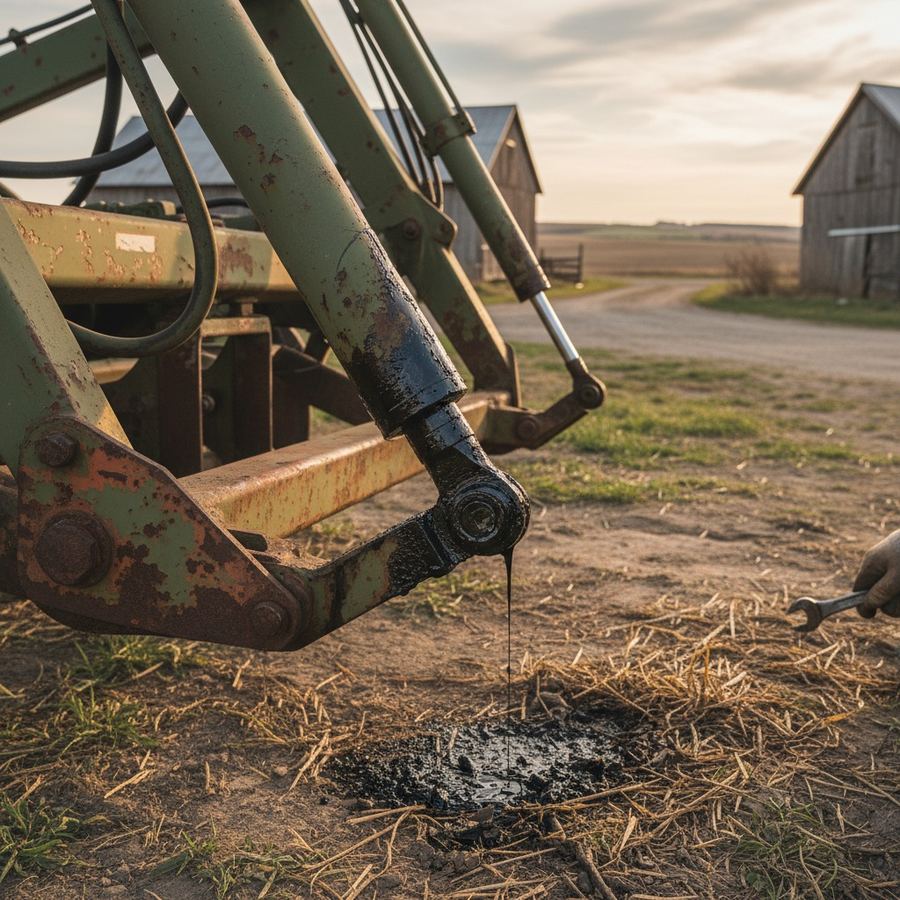
Visible cylinder leaks are obvious. Look at loader cylinders, 3-point lift cylinders, steering cylinders, and remote cylinders on implements. If there is oil weeping down the rod, wet around the gland nut, or pooled on the axle housing under the cylinder, the rod seal has let go. A rebuild kit is $25 to $75, a new cylinder is $200 to $600. Visible leaks are mostly a price-negotiation item, not a walk-away.
Invisible leaks are the problem. A loader bucket that settles to the ground in two hours is telling you the cylinder seals are bypassing internally, or the control valve in the loader joystick has a worn spool, or the check valve in the loader valve stack has failed. To isolate it, put a weight on the bucket, mark the rod position, and watch for 20 minutes. Then crack the hose at the cylinder with the bucket blocked up. If the leak is at the cylinder, you will see oil at the cracked fitting. If the cylinder holds after you block the line, the leak is upstream at the valve.
Remote Valves: Sticky Spools, Bad Detents, and Drift
Remote hydraulic valves on older tractors take abuse. They leak, they stick, they lose detent (the feature that holds the lever in position while oil flows), and they drift under load. Before you buy a tractor with remotes, cycle every one of them. Run the spool to each position. Does it return to center? Does the detent catch and hold at the float position? If you connect a cylinder and hold a load, does the cylinder stay put or does it slowly settle? How fast?
A little drift is normal on a 40-year-old valve with worn spools. A lot of drift means the valve is done and you are looking at a rebuild or a replacement. Individual remote valves for most tractors run $200 to $600 new, less rebuilt, and swapping one is usually straightforward if the linkage has not rusted into place.
Quick-Couplers and Trapped Pressure
If you cannot connect an implement hose to the tractor's remote couplers, the problem is almost always trapped pressure in the implement hose. Crack the fitting at the implement end to release it. If the tractor's couplers are leaking or damaged, budget $40 to $80 each to replace. If the coupler body leaks where it threads into the valve, the valve body has been abused.
Pressure Testing: Simple and Telling
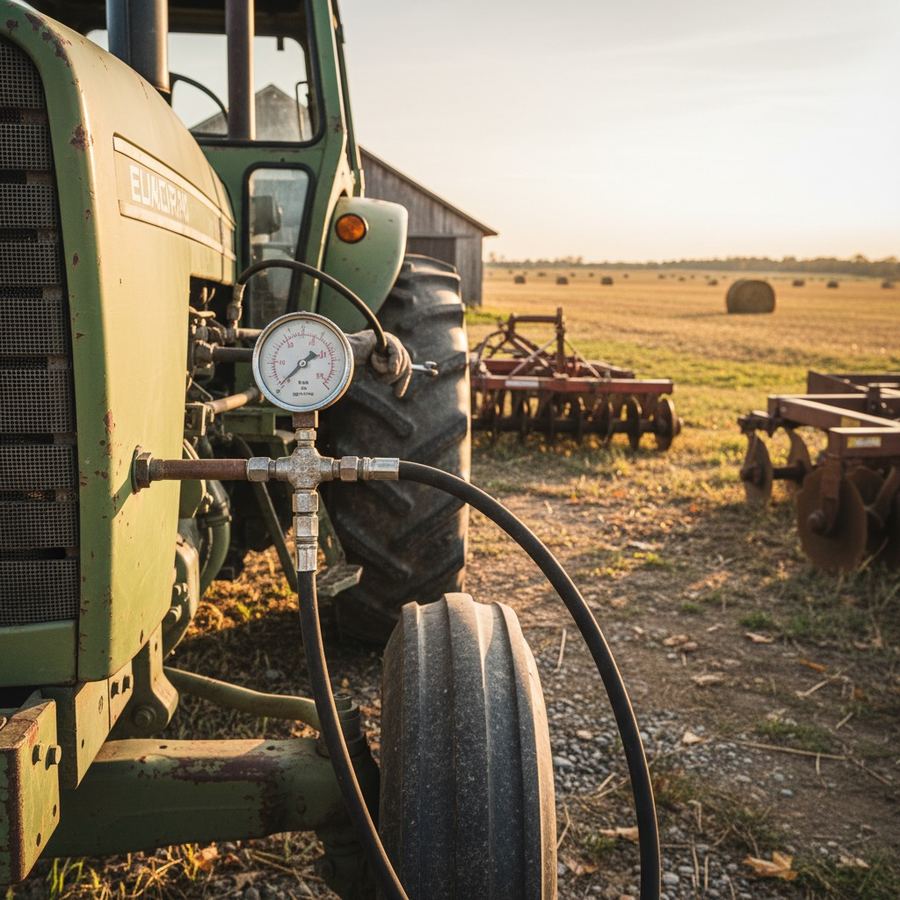
A hydraulic pressure test is the single most useful inspection you can do on a used tractor, and it takes 15 minutes. You need an inline pressure gauge rated for 3,000 PSI or higher and the right fittings to connect it to a remote outlet. Most open-center older tractors run relief pressures in the 1,500 to 2,500 PSI range. Closed-center systems generally run higher, 2,500 to 3,000 PSI, and some modern machines run 3,500+ PSI.
Connect the gauge, deadhead the circuit (run the cylinder to full extension or retraction so flow stops), and read the gauge at full throttle. Compare to the spec in the operator's manual. A reading 10 to 15 percent below spec means the pump and relief valve together are not making full pressure; it could be either. A reading 30 percent below spec means the pump is worn out and you should budget for a rebuild. A reading that builds slowly and then drops means you have internal leakage somewhere that is worse under heat.
PTO-Driven Hydraulic Pumps on Older Tractors
Some 1960s and 70s tractors, particularly certain Massey and Ford models, used a hydraulic pump driven off the PTO shaft or off a gear in the timing cover rather than a direct engine-driven pump. When these fail, the symptoms mimic other problems (slow lift, weak steering) but the root cause is a pump that is physically inaccessible without pulling the timing cover or splitting the tractor. Rebuild costs on these are in the $600 to $1,500 range once labor is included, and you want to know which design you are buying into before you commit. Check the service manual section layout for where the pump actually lives.
The Buyer's Load Test
Forget cycling an empty loader. The only meaningful hydraulic test is a loaded test. Put a round bale on the front loader, or ask the seller to put weight in the bucket. Lift it to full height and hold it. Does lift speed drop off noticeably under load versus empty? Does the loader sag visibly over 30 seconds with the lever in neutral? Does the engine bog more than expected? Then raise the 3-point with an implement on it (even a blade or a mower is enough) and do the same test. A tractor that lifts an empty loader fast and a loaded loader slow is telling you the pump is on its way out.
Steering is part of the hydraulic system too on anything with power steering. Turn lock to lock at idle and at working RPM, with the loader empty and with the loader loaded. Hard steering under load usually means the steering priority valve or the steering orbital is worn.
When to Walk Away
Walk away from a tractor where the hydraulic oil looks like chocolate milk (water contamination), where there is metallic glitter on the drain plug magnet (catastrophic pump wear), where multiple functions are slow and weak together (system-wide pressure loss, often the pump), or where you can hear the pump whining or cavitating at idle (suction side restriction or air leak, both expensive to chase).
A single slow function on an otherwise solid machine is a negotiation item. Whole-system weakness is a walk-away unless the price already reflects a full hydraulic rebuild. For the broader inspection approach that puts these tests in context, our pre-purchase inspection guide walks through the full sequence. For related wear areas, see the PTO, clutch, and transmission warning signs piece and the notes on what to check on older diesel tractors. If you end up needing parts to fix what you find, where to find parts for legacy tractor models has the sourcing details.