There is a running joke in the grain farming community that a John Deere 7000 planter will still be planting corn when the tractor pulling it has been scrapped, melted down, and turned into something else. It is not entirely a joke. The JD 7000 was built from 1974 to 1986, and clean working examples still show up at spring sales, get pulled home, get new seed discs and closing wheels, and plant another crop without complaint. Seeding equipment, more than almost any other implement category, rewards patience and punishes the buyer who grabs the cheap one without looking.
Drills versus planters
The first decision is what you are planting and how. Grain drills place small seeds (wheat, oats, barley, soybeans, rye, alfalfa) in narrow rows typically 6 to 10 inches apart. Planters place larger seeds (corn, soybeans on wider rows, cotton, sunflower) in wide rows typically 15 to 38 inches apart at a specific population per acre. A drill does not care much about spacing accuracy within the row. A planter cares a lot.
If you are a small grain or forage operation, you need a drill. If you are a row crop operation, you need a planter. Some operations own both. Some operations drill soybeans with a no-till drill and plant corn with a row crop planter. The equipment choice flows from the crop rotation.
Grain drills
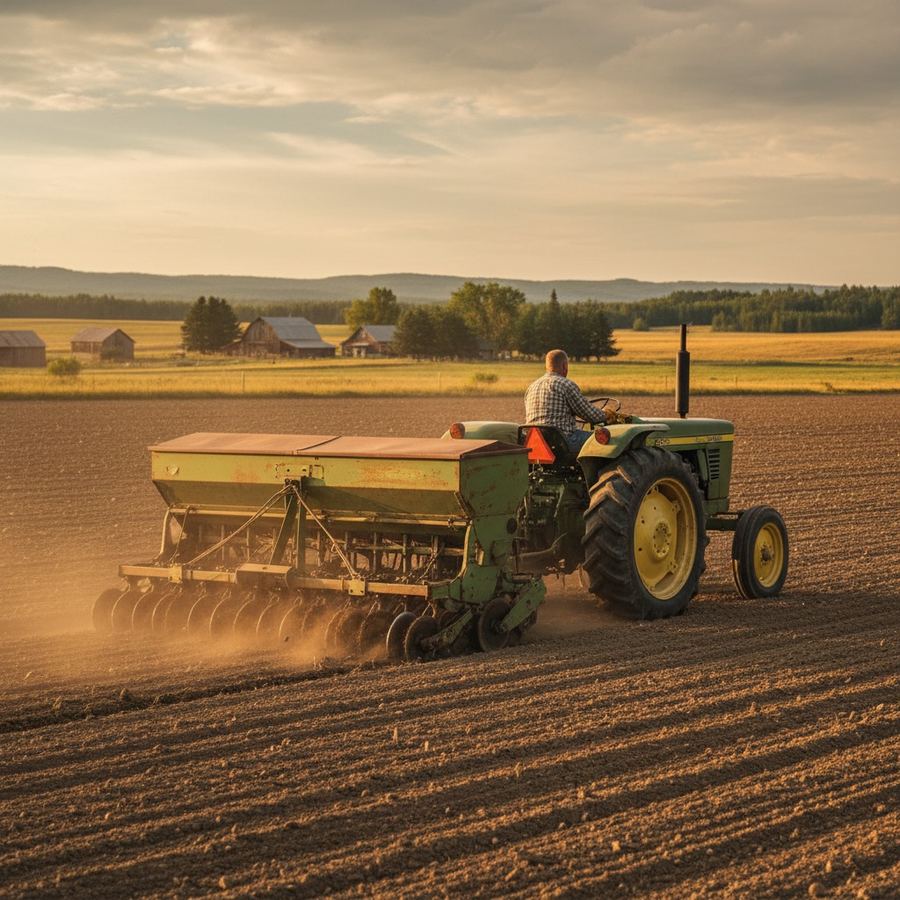
The John Deere 8000 series drills from the 70s and 80s are the most common used conventional grain drills in North America. The 8300 and 8350 box drills with 10 or 12 foot working widths, press wheels, and grain-grass-fertilizer boxes are everywhere. Prices for an 8350 in working condition run $1,500 to $5,000. Condition ranges wildly because they are simple machines and many have been parked in the weeds for a decade. Look at the box interiors for rust-through, check the seed cups for wear, and spin the ground drive wheels to verify the chain drive is intact.
The International 5100 and 5300 drills are the red equivalent. Great Plains grain drills from the 80s onward are well built and show up on the used market in the 10 to 15 foot widths that match small operations. Sunflower 9412 and 9435 drills are heavier units intended for commercial operations and bring higher prices.
The John Deere 750 no-till drill is the gold standard in the no-till drill category. Built from 1989 to 2005, the 750 placed grain and small seeds into heavy residue at consistent depth with a single-disc opener and a press wheel system that actually worked. Used 750s have appreciated over the past ten years. A clean 15 foot 750 now sells for $12,000 to $25,000 depending on opener condition and markets. The later JD 1560, 1590, and 1990 CCS drills are more capable and more expensive, running $18,000 to $60,000 used.
Great Plains 3P-series no-till drills are the other major name in this category. A Great Plains 1006NT or 1006NT-II in 10 foot working width with good openers runs $8,000 to $18,000 used.
Grain drill inspection is about openers, seed metering, and press wheels. On a disc-opener drill, the opening disc should be round and flat. Worn opening discs get oval-shaped and cut a wider slot than they should, which hurts seed placement and stand consistency. Disc replacement runs $60 to $120 per opener depending on brand. A full reblade on a 15 foot no-till drill can hit $1,500 to $3,000. On a hoe-opener drill, the hoe points wear at the tip and are replaceable for $15 to $40 each.
Seed metering on older box drills uses a fluted roll for grain and a separate roll for grass seed. Look at the flutes for wear and broken edges. Worn flutes mean uneven seeding rates. Press wheels and press wheel arms should move freely with no bent axles or broken springs.
Row crop planters
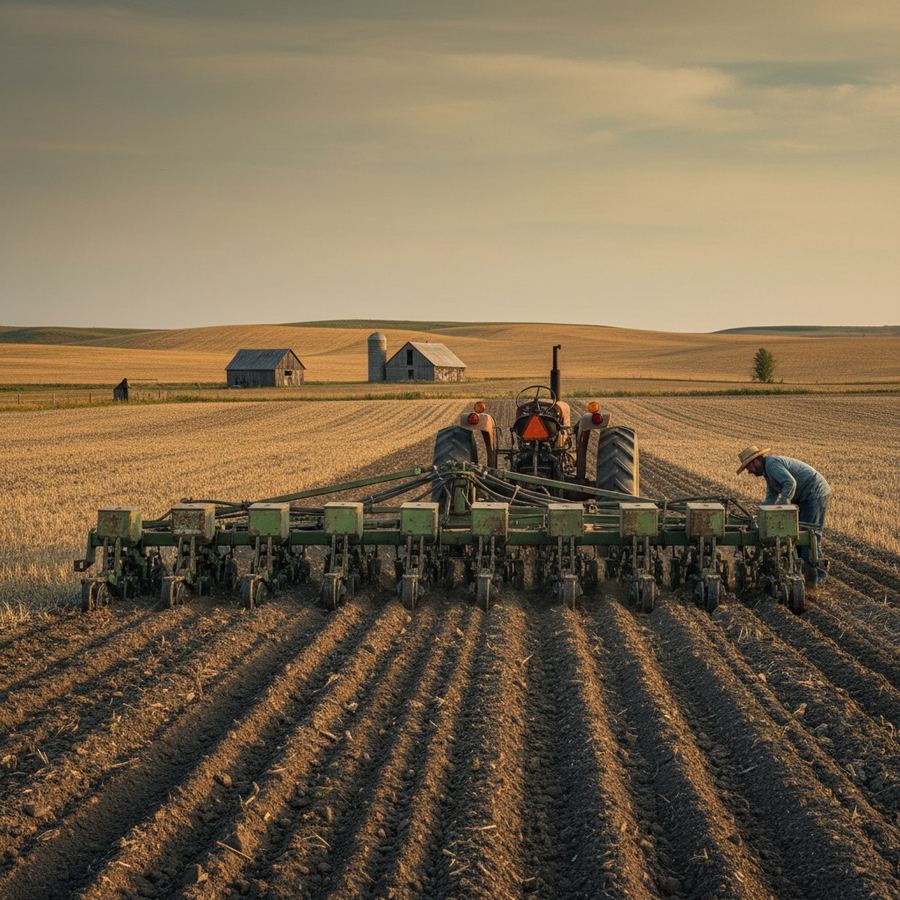
The John Deere 7000 series planter is the classic used row crop planter. Built in 4, 6, 8, and 12 row configurations from 1974 to 1986, with a refined 7100 version following, the 7000 has a finger-pickup seed meter that works reliably when parts are fresh. A 6 row 7000 in working condition runs $2,500 to $8,000 depending on row units and monitor. Add $1,500 to $3,000 for a working seed monitor. Row unit rebuild kits with new seed discs, brushes, bearings, and finger pickups run $75 to $200 per row.
The JD 1240 corn planter is the older 60s-era Deere planter that predates the 7000. It uses a plate-type seed meter and is still found on small operations. A 4-row 1240 sells for $1,000 to $3,000 in working condition.
Case IH 800 and 900 series planters are the red competitors to the 7000. They are well regarded and parts support is still good. Kinze 2000 and 3000 series planters offered advantages in row unit design, seed tube accuracy, and monitor integration, and have become popular on used lots. A Kinze 2000 8-row in clean condition brings $8,000 to $18,000. A Kinze 3000 series with bulk seed hoppers and a working monitor runs $15,000 to $35,000.
White 5100 and 6100 series planters are less common but have a following among operators who ran them. International Cyclo planters use an air-drum metering system that is very different from finger pickup and has its own ecosystem of parts and quirks.
What to inspect on a planter
Planter inspection is more involved than drill inspection because the population accuracy matters so much. A drill that plants 5 percent more or less seed than the target is not a disaster. A corn planter that is off by 5 percent is leaving yield on the ground.
Start at the row units. Each row unit is a small assembly with an opener disc, a seed meter, a seed tube, a closing wheel, and a depth wheel. Everything on that row unit wears. Opener discs should be straight and round. Seed tubes should be clean inside with no cracks or broken brackets. Closing wheels should spin freely and not be bent or cracked. Depth wheels should be firm against the opening disc with no gap.
Pull the seed meter off one row unit and look at it. On a finger pickup meter, check the fingers for wear, the brush belt for missing bristles, and the drive for free rotation. On a vacuum meter, check the seed disc for worn holes and cracked singulators. Seed meter condition accounts for most of the difference between a planter that plants to target population and one that doubles every tenth seed.
Check the drive system. Older planters use chains and sprockets to drive the row units from a ground wheel. Chains stretch, sprockets wear, and slip clutches slip when they should not. On later planters with hydraulic or electric drive, the complexity goes up and the diagnostic skill required goes up with it.
Look at the frame for cracks and weld repairs. A planter that has been pulled heavy for 20 years can develop cracks in the main tool bar, particularly at bracket weld points where row units bolt on. Cracks at these points are expensive to fix properly.
Verify the monitor works if the planter has one. A seed population monitor is what tells the operator the planter is actually planting. A non-working monitor is a $500 to $2,000 repair depending on age and brand. Budget for it if the monitor does not come on during inspection.
Used prices versus new
New planters are expensive in a way that stops conversations. A new 16 row Deere or Case IH with variable rate, row shutoffs, and downforce control lists well over $200,000. A working 8 row used planter that is 25 years old can be bought for $8,000. The older machine will not match the new one on technology, but it will put seed in the ground at the right depth and population for a fraction of the cost. That gap is why the used seeding equipment market stays busy.
If you are building an equipment lineup, match the drill or planter to the scale you are planting. A 10 acre soybean field does not need a 15 foot no-till drill. A 100 acre corn field can run a 6 row 7000 comfortably. The articles on used row crop tractors and sizing tractors for acreage cover the tractor side of that decision. The general listing red flags guide applies to planter ads as much as it does to tractor ads, particularly ones that do not show the row units up close. USDA and university extension services also publish free resources on planter calibration worth a Saturday afternoon reading.
Finally, buy the planter that was stored inside. A 7000 that lived in a machine shed for 40 years is a tool. A 7000 that lived under a tarp in the weeds is a project. The prices are usually less different than you would think.