A 20 foot John Deere 980 field cultivator with straight shanks and new sweeps will work ground for another twenty years and costs roughly the same used as a three-year-old ATV. Tillage equipment is the best value per working hour in the entire farm equipment market. It does not have an engine, it does not have a transmission, it does not care how it was stored as long as it did not rust apart, and the things that do wear out are cheap to replace. For anybody buying used, the tillage aisle is where a modest budget goes the furthest.
Primary versus secondary tillage
The standard framework splits tillage into two stages. Primary tillage breaks ground after harvest or before planting, moving a lot of soil, burying residue, and opening up compaction. Moldboard plows, chisel plows, subsoilers, and offset disks do this work. Secondary tillage smooths and sizes the seedbed, incorporates chemical, and kills small weeds. Field cultivators, tandem disks, harrows, and rolling baskets handle this part.
In a reduced-tillage or no-till system the whole framework collapses and you might skip primary tillage entirely. But for anybody running a conventional rotation, the two-stage approach still shapes what equipment you need. A 100 acre corn and bean operation in the Midwest will typically own a chisel plow, a tandem disk, and a field cultivator, and run each one once or twice a year. Every one of those three can be bought used for under $10,000 if you are willing to shop.
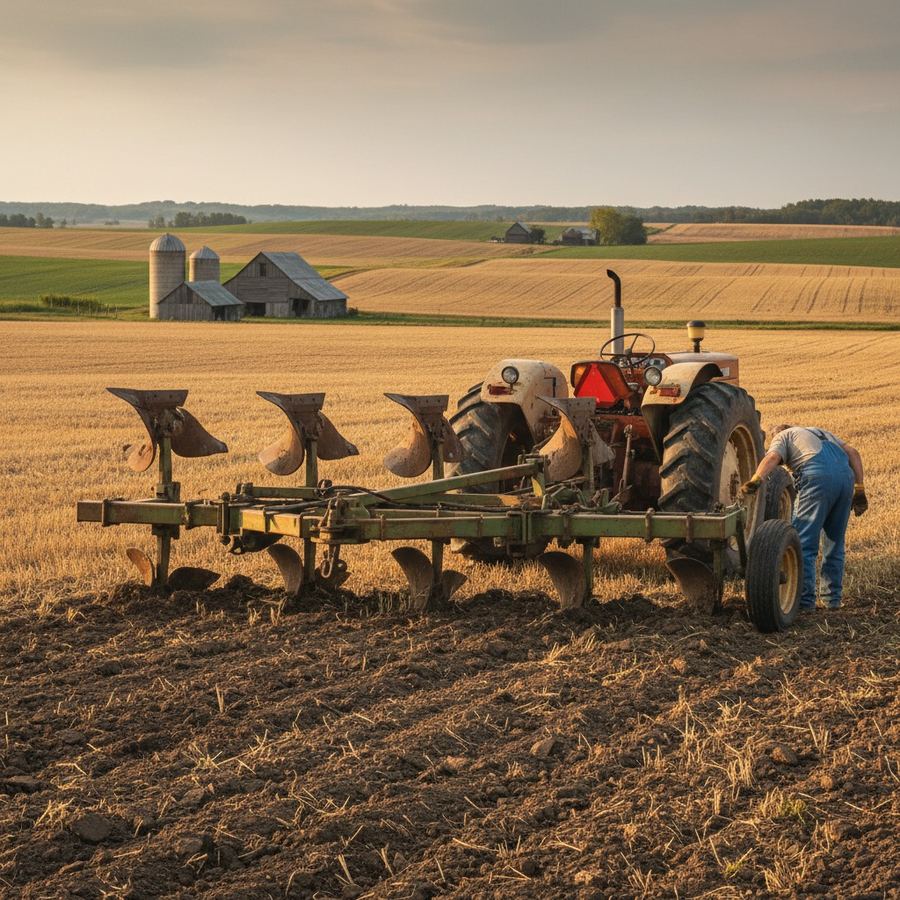
Moldboard plows
The moldboard plow is the original farm implement, and it is slowly disappearing from active use for good reasons. It is slow, it burns diesel, it buries crop residue so completely that erosion becomes a problem, and it leaves a plow pan under the furrow slice that has to be broken up later. But it still has its place for turning in sod ground, for setting up a field that has been in pasture for a decade, and for any operation where burying weed seed is more important than preserving residue.
The John Deere F145 series 4-bottom and 5-bottom trailing plows from the 70s are still out there at farm sales, usually for $800 to $2,500. The International 720 and 730 plows are similarly cheap and similarly capable. Kverneland 4 and 5 bottom plows show up occasionally and bring more because they have a following among guys who still plow seriously.
Inspection is simple. Look at the moldboards and shares for cracks and heavy wear on the cutting edge. Shares are wear parts and a set for a 5-bottom plow runs $200 to $500. Check the frame for straightness and the trip mechanism if it has one. If the plow has a hydraulic lift cylinder, cycle it and look for leaks. The art of plowing is mostly about getting the plow adjusted right, not about whether the iron is serviceable.
Chisel plows
Chisel plows have replaced moldboard plows in most operations because they achieve most of the same depth and compaction relief without completely burying residue. A JD 1610 chisel plow with 23 shanks and a 3-bar harrow is a classic setup. An IH 5500 Tiger Mate or the later Case IH equivalents are equally common. Sunflower chisel plows from the 80s and 90s are heavy built and popular in the Plains states where they get used in hard, dry ground.
Chisel plow inspection centers on the shanks, the springs, and the hydraulic cylinders. Shanks wear at the points and get bent when they hit rocks. Replacement shanks are $80 to $200 each depending on the tool. Spring-reset shanks have coil springs that lose tension over time. Check several of them for matching return force. Weak springs will let shanks ride up under load. Check the hydraulic cylinders for rod pitting and seal leaks. A chisel plow with a blown lift cylinder is still serviceable because the cylinder is $300 to $500 to replace, but you should know before you buy.
Prices for a 15 to 20 foot chisel plow in working condition run $3,500 to $9,000. A 25 to 30 foot unit with a folding frame runs $6,000 to $15,000. These are ridiculous values for a tool that will outlive the tractor pulling it.
Disks
Disks come in two flavors: offset disks used for primary tillage in heavy trash or pasture ground, and tandem disks used for secondary tillage. Offset disks from Rome, John Deere, and International are built heavy and look intimidating because they weigh 10,000 pounds in a 10 foot working width. Tandem disks are lighter and work faster.
The John Deere 220 series tandem disk is the most common used disk in the country. An IH 490, IH 770, Krause tandem, or Sunflower 1232 all do the same job with minor differences in blade diameter and gang spacing. For a 15 to 20 foot tandem disk in working condition, expect to pay $3,000 to $8,000. For a heavy offset disk in 10 to 14 foot widths, $2,500 to $7,000 is typical.
Disk inspection is about blades, bearings, and gang bolts. Look at the blade diameter. New blades on a tandem disk are typically 20 to 22 inches. Worn blades can be down to 16 or 17 inches and will not penetrate the way they should. A full reblade on a 20 foot disk runs $1,500 to $3,000 depending on blade count and supplier. Spin the gangs by hand if you can. Bearing noise or resistance means bearing replacement in your future. Check the gang bolts for looseness. A loose gang bolt is the number one reason a disk throws blades in the field.
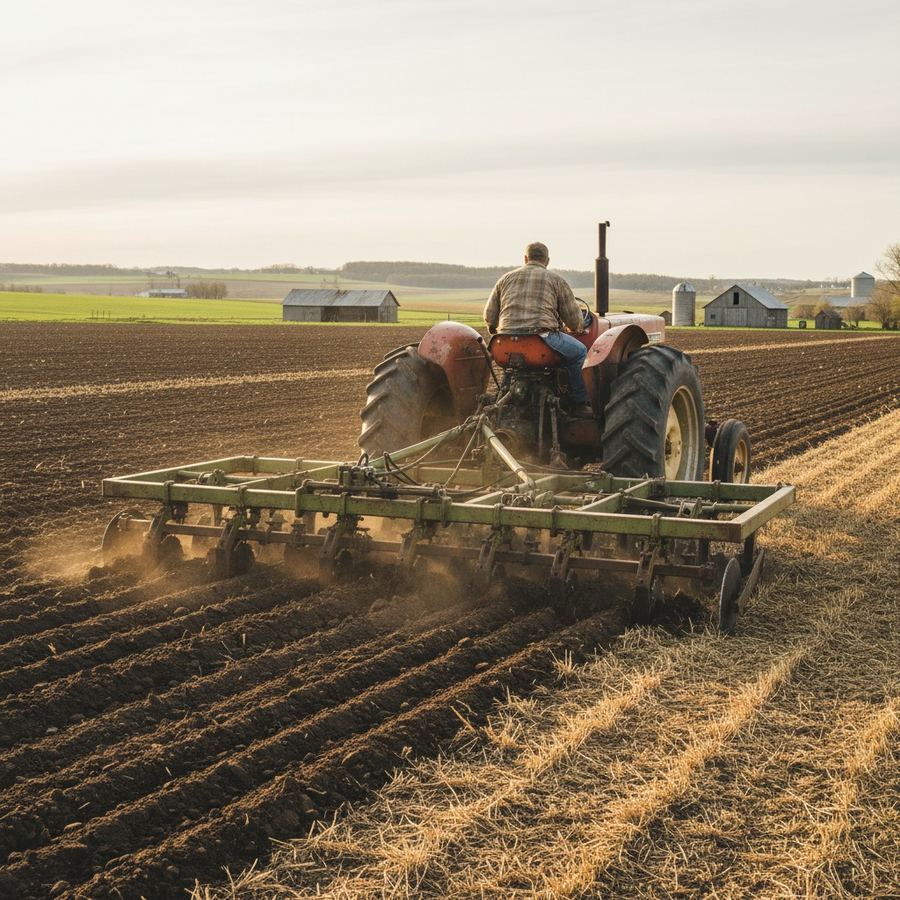
Field cultivators
Field cultivators are the workhorses of secondary tillage and the best value in the used market. A John Deere 980 in a 20 to 30 foot working width is a machine that will show up at every sale in the Midwest. A Case IH Tigermate II is the equivalent red machine. Sunflower 5135 and 5055 cultivators are heavy built and well regarded. DMI and Wil-Rich cultivators round out the common brands.
A 20 foot field cultivator with S-tine shanks, working folding wings, and good sweeps sells for $3,500 to $9,000 in the Midwest. A 30 foot unit runs $7,000 to $16,000. A 40 foot unit with a harrow and rolling basket attachment can hit $25,000 but is still a fraction of new price.
Inspection: sweeps are wear parts and a full set for a 30 foot cultivator runs about $400 to $700. The S-tines themselves rarely break but the mounting brackets can crack where they bolt to the main frame. Look carefully at the wing hinges and the locking pins. A folding cultivator that has been dropped or operated with a loose wing will have elongated pin holes that cause alignment problems. The frame cross tubes should be straight. A bent cross tube will make the cultivator run unevenly across its width and leave ridges and valleys in the soil.
Matching tillage width to horsepower
The rough rule for chisel plows is 10 to 14 PTO horsepower per foot of working width in average ground. For tandem disks it is 6 to 10 horsepower per foot. For field cultivators it is 4 to 6 horsepower per foot. A 140 horsepower tractor can reasonably pull a 12 foot chisel plow, a 20 foot disk, or a 30 foot field cultivator. Undersized tractors will struggle in wet or heavy ground. The tractor articles on used row crop tractors and used utility tractors cover the horsepower side of this equation.
Tillage tools get sold for less than they are worth because they are unglamorous and they sit at the back of dealer lots. If you are willing to pull a weed-grown cultivator out of the hedge row and spend a Saturday greasing it, cleaning the sweeps, and checking the shanks, you can assemble a complete tillage setup for less than the cost of one new implement. A lot of these pieces turn up at farm sales, and the article on how auctions differ from dealer purchases is worth reading before you bid. That is the quiet advantage of shopping this part of the used market seriously.