Pre-1990 diesel tractors are the sweet spot for used buyers right now. No emissions electronics to break, no DEF to buy, injection systems are mechanical and fixable in any decent shop, and a well-kept one will outlive any current-production compact. The catch is that these machines are 35 to 60 years old and every one of them has been sitting somewhere at least part of its life. Before you buy an older diesel, there are specific checks that matter more than anything a generic inspection covers.
The Cold Start Test Tells You Almost Everything
Show up early, before the seller has had a chance to run it. Put your hand on the block. If it is warm, the seller started it earlier and cooled it off, and you should be suspicious. An honestly cold engine is the single most important part of evaluating an older diesel because a warm diesel will start and run on cylinders that are failing on a cold one.
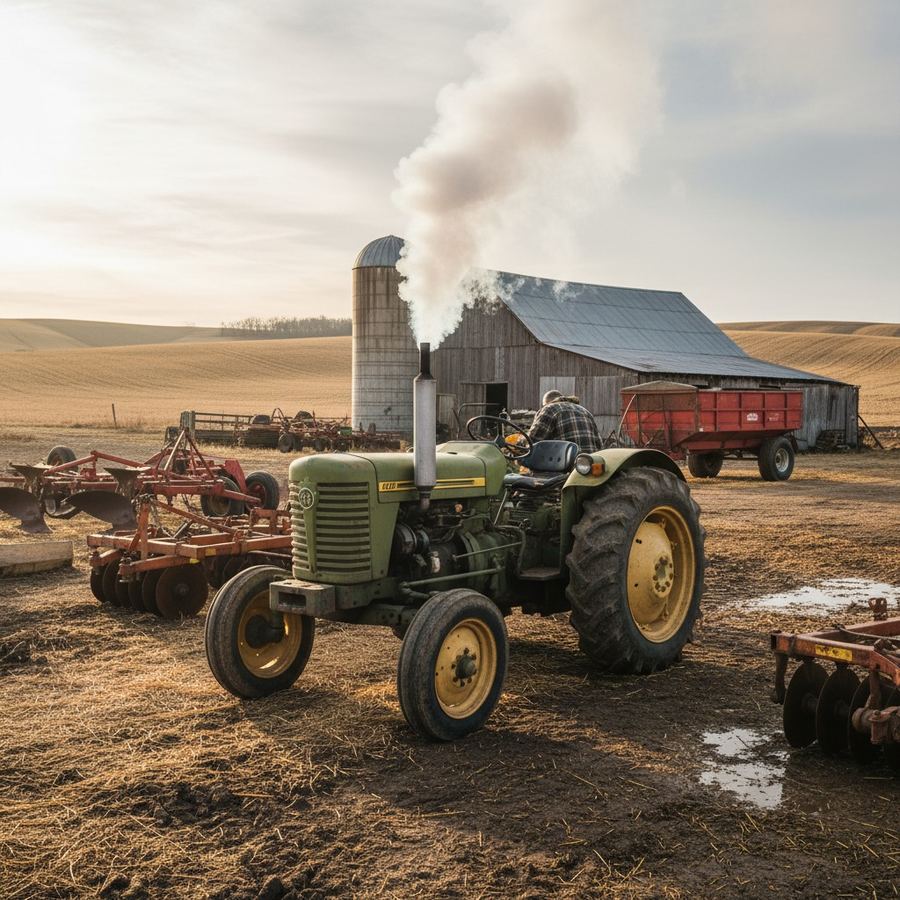
Crank it yourself and watch the exhaust stack. Normal cold start on a healthy older diesel: 3 to 8 seconds of cranking on glow plugs or ether (if the tractor is equipped with a cold start aid), a clean fire, a puff of white smoke from unburned fuel that clears within 30 to 60 seconds, and then a steady idle with no smoke visible from the stack. On a Perkins 3.152 or 4.236 in an MF 135 or 165, on a JD 4.276 in a 2040 or 2240, on an IH D310 in a 706, the cold start should look roughly the same.
What the smoke tells you:
Blue smoke that lingers for two minutes or more, especially if it thickens when you blip the throttle, means oil is burning. Either worn rings, worn valve guides, or a turbo seal leaking on turbocharged models like the JD 4440 or the IH 1066. A full in-frame overhaul on a 4-cylinder Perkins runs $2,500 to $4,500 in parts, more if the crank needs grinding. On a 6-cylinder JD or IH you are looking at $4,500 to $8,000.
White smoke that will not clear after the engine warms up is either unburned fuel (weak compression, worn injectors, stuck rings) or coolant entering a cylinder through a head gasket or cracked head. Pull the radiator cap after it warms up and look for bubbles or an oily film. Bubbles mean combustion gases are getting into the coolant through the head gasket.
Black smoke at idle is usually fuel system. A partially clogged air filter or a single injector stuck open. Black smoke only under load is more likely worn injectors or a slightly over-fueling injection pump, both fixable. On Stanadyne rotary pumps common on JD 4020 and similar, the pump itself rarely fails but the pump-mounted lift pump and the advance mechanism get worn.
Glow Plugs and Cold Start Aids
Smaller diesels, particularly Kubota L-series and the Ford 1000/1500/1700-series Japanese imports, use glow plugs that are energized for 5 to 15 seconds before cranking. A dash light usually indicates the cycle. If the seller skips the glow plug cycle and the tractor still starts instantly on a 45 degree morning, either the tractor has a lot of compression and is in great shape, or the seller has been hitting it with starting fluid and you cannot tell.
Ether is a shortcut that has killed more old diesels than anything else. Used regularly on a cold engine, starting fluid hammers the rings and cracks pistons. A tractor that needs ether on a mild morning has low compression, bad glow plugs, bad injectors, or all three. Red flag, not a workaround.
Injection Pump Leaks and Known Pumps
Two main injection pumps show up on older North American diesel tractors: Bosch inline pumps (used on most IH tractors, many JDs from the 1960s and 1970s, and the bigger 6-cylinders) and Stanadyne rotary pumps (Roosa Master was the original name, used on many JD and some IH and Massey machines).
Bosch inline pumps are nearly indestructible when they are kept clean. They leak at the element heads and the governor cover when seals dry out after years of sitting. A weep from the governor cover is not a disaster. Seeping fuel around the pump base where it bolts to the block can mean the internal transfer pump seals are gone, which does require a pump rebuild. A Bosch inline rebuild on a JD 4440 pump runs $800 to $1,800 at a diesel shop.
Stanadyne rotary pumps are more sensitive. They need clean fuel, they hate water, and they have an advance mechanism that wears out. Signs of a tired Stanadyne: hard hot start, smoke under load that was not there cold, a governor hunt at low idle. A Stanadyne rebuild runs $600 to $1,400 depending on the parts needed.
On either pump, look at the fuel filter housing. A cracked fuel filter housing is common on MF and Perkins-powered tractors that froze with water in the fuel. Replacement housings can be found used but sometimes run $200 to $500 new.
Model-Specific Issues Worth Knowing
Perkins 4.236 and 4.248, the 4-cylinder diesels in thousands of MF, Case, and British Ford tractors. Known for head gasket weakness after 6,000 hours of hard use. A weep at the head gasket at the front or rear of the block on the exhaust side is typical. A head gasket job on a Perkins 4-cylinder is about a weekend in a home shop, parts $150 to $400.
JD 6-cylinder diesels in the 4020, 4230, 4430, 4440 are tough engines. The known weakness on the 4430 and 4440 is injector wear around 5,000 to 8,000 hours. New injectors are $180 to $300 each, and there are six. Budget $1,500 for an injector service. The other 4440 known issue is the Sound-Gard cab AC system, which is not an engine issue but is often non-functional on used 4440s and is not cheap to fix.
Kubota L-series from the 1980s and early 1990s, particularly the L2050, L2250, L2550, L2850. These are tough little tractors but they have a specific failure mode where injectors seize after sitting for years. A tractor that cranks and cranks without firing, after sitting in a barn for a decade, often has stuck injectors rather than anything catastrophic. Pulling and cleaning or rebuilding the three injectors usually brings it back. Budget $200 to $500.
IH 706, 806, 1066 with the D310, D360, and DT414 diesels. The non-turbocharged versions are extremely reliable. The turbocharged DT414 in the 1066 has a known weakness in the turbo itself after hard hours and a known tendency to weep oil from the rocker cover. Turbo rebuilds run $400 to $900.
Compression Test If You Can
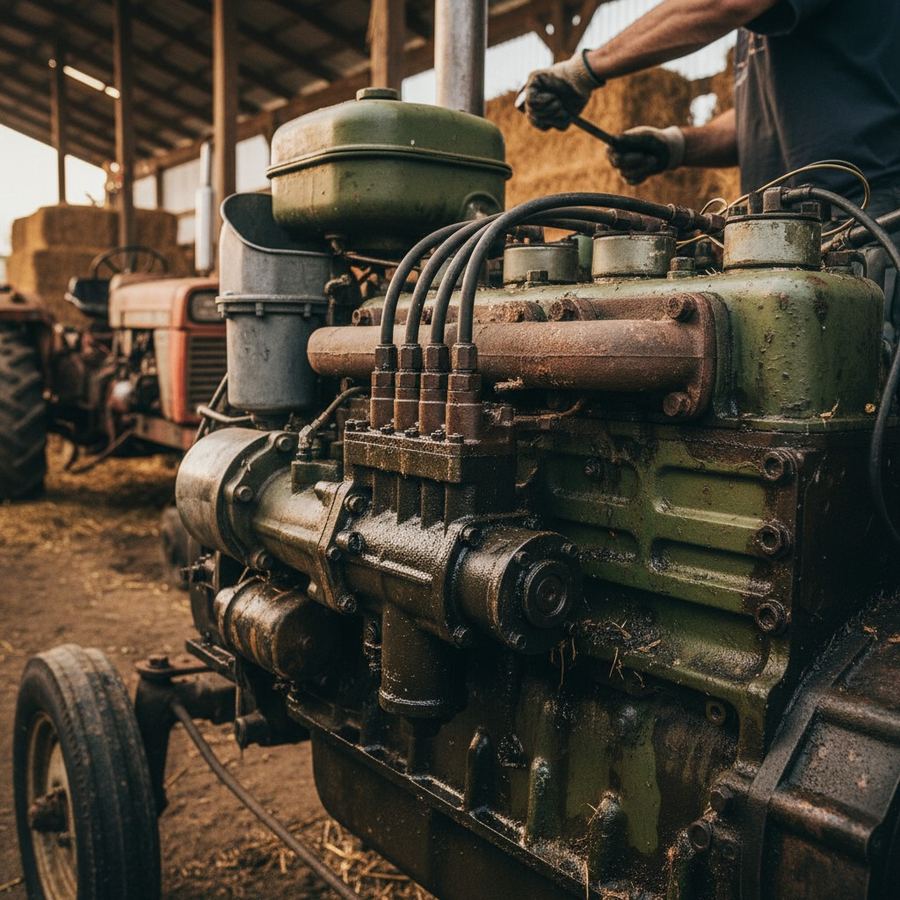
If the seller will allow it and you have a compression tester with the right adapter (usually a glow plug thread or an injector thread adapter), a compression test on each cylinder is the single best diagnostic on an older diesel. Healthy older diesels should show 300 to 450 psi per cylinder, within about 10 percent of each other. A cylinder 50 psi lower than the others is worn or has a stuck ring.
Realistically, most sellers will not let you pull injectors or glow plugs on a tractor you have not bought yet. A close second is listening carefully at idle and under load, feeling the exhaust pulses at the stack with your hand (they should be even), and watching for any cylinder that is clearly weaker than the others.
Walk-Away List for Older Diesels
Walk away from: milky oil on the dipstick, a block that was warm when you arrived, coolant that bubbles at the radiator cap when running, a bottom end knock, or an injection pump that is dripping fuel onto the block steady enough to pool. These are all fixable problems but at numbers that usually exceed the value of the tractor.
Everything else is a negotiation. A tired old diesel with weepy seals, a worn injector, and a dirty fuel system can usually be brought back for under $1,000 in parts and a weekend of work, and it will run another 20 years. For the rest of the inspection, our full walkthrough on how to inspect a used tractor before buying covers everything beyond the diesel-specific checks. And if you are worried about what the hour meter is telling you on a pre-1990 machine, our notes on what hours matter on a used tractor explain why 6,000 hours on a JD 4020 is not what it sounds like. For parts sources on these older engines, see our guide to where to find parts for legacy tractor models.