Here is the counterintuitive thing nobody tells first-time buyers of older iron: parts for a 1968 Ford 4000 are usually easier to get than parts for a 2008 utility tractor with an obsolete dash cluster and an emissions module the manufacturer quit stocking. Legacy tractors have an ecosystem around them. OEM dealers, aftermarket specialists, salvage networks, and forums have been propping up the big production-run machines for decades, and most of what you need is a phone call or a few clicks away. The trick is knowing where to look, because every source has its own strengths and its own nonsense.
OEM Dealer Networks: Still the Right Call Sometimes
John Deere is the benchmark for legacy parts support. If you own a 4020, a 4440, a 2010, or almost anything in the 20-series and 30-series line, your local JD dealer can usually still order most of the wear parts from the parts catalog. Prices are OEM prices (read: not cheap), but the parts fit, the gaskets seal, and you get a part number you can cross-reference elsewhere if you want to shop around. Kubota dealers are similar for their B, L, and M series from the 80s and 90s. Case IH has reasonable legacy support for big names like the 1066 and the 7140, thinner coverage on oddball Case Agri-King stuff from the 70s.
Where it gets spotty: Ford-New Holland for pre-merger Ford tractors, Massey Ferguson for Perkins-era machines, and anything AGCO now owns but did not build. You will often find the parts counter pulling out a book the thickness of a phone directory, discovering the number is active, and then quoting you a price that ends the conversation. Get the number, walk out, and go shop it at an aftermarket house.
Aftermarket Specialists: Where Most Legacy Owners Actually Shop
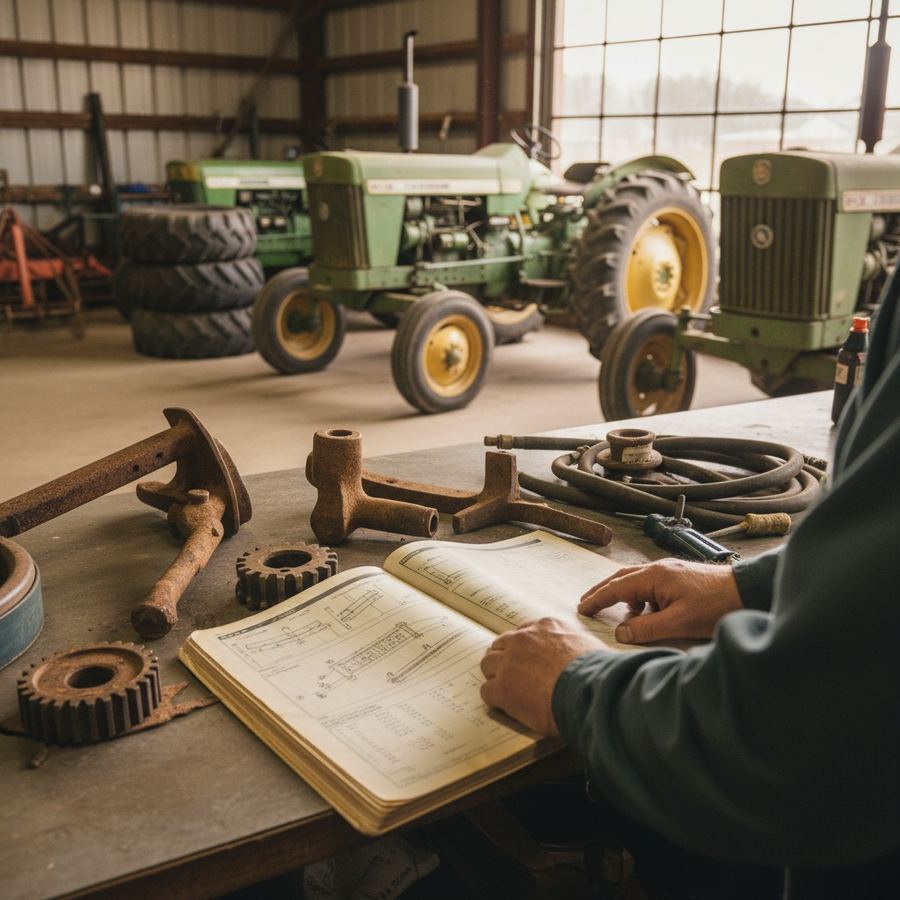
Steiner Tractor Parts is the first name that comes up in any conversation about old tractor restoration. Their catalog is enormous and covers IH, Farmall, Allis-Chalmers, Oliver, Cockshutt, Minneapolis-Moline, Massey, Ford, and JD going back to the hand-crank era. Quality runs from decent reproduction sheet metal to genuine-equivalent engine parts. Prices beat OEM, sometimes by half. If you need a hood for a Farmall 560 or a seat cushion for an Allis D17, they have it.
Yesterday's Tractor Co. is the other big one, strong on Ford, JD, and general hardware, and their online forums have been running for over 20 years with searchable archives of every repair question you could ever have. TractorJoe is cheaper, a little rougher on quality, good for filters, seals, bearings, and tune-up parts where the tolerances are forgiving. Quality Farm Supply and Messicks round out the list for mid-range buyers. Reliable Aftermarket Parts has a broad catalog and will often undercut Steiner on specific items.
The trade-off with aftermarket is always the same: you get 80 percent of OEM quality for 50 percent of the price, and sometimes you get 95 percent of OEM quality for 50 percent of the price, and occasionally you get a reproduction gasket that will not seal no matter what you do. Keep your receipts and do not throw the core away until the new part is in and working.
Salvage Yards: Where the Good Stuff Is Hiding
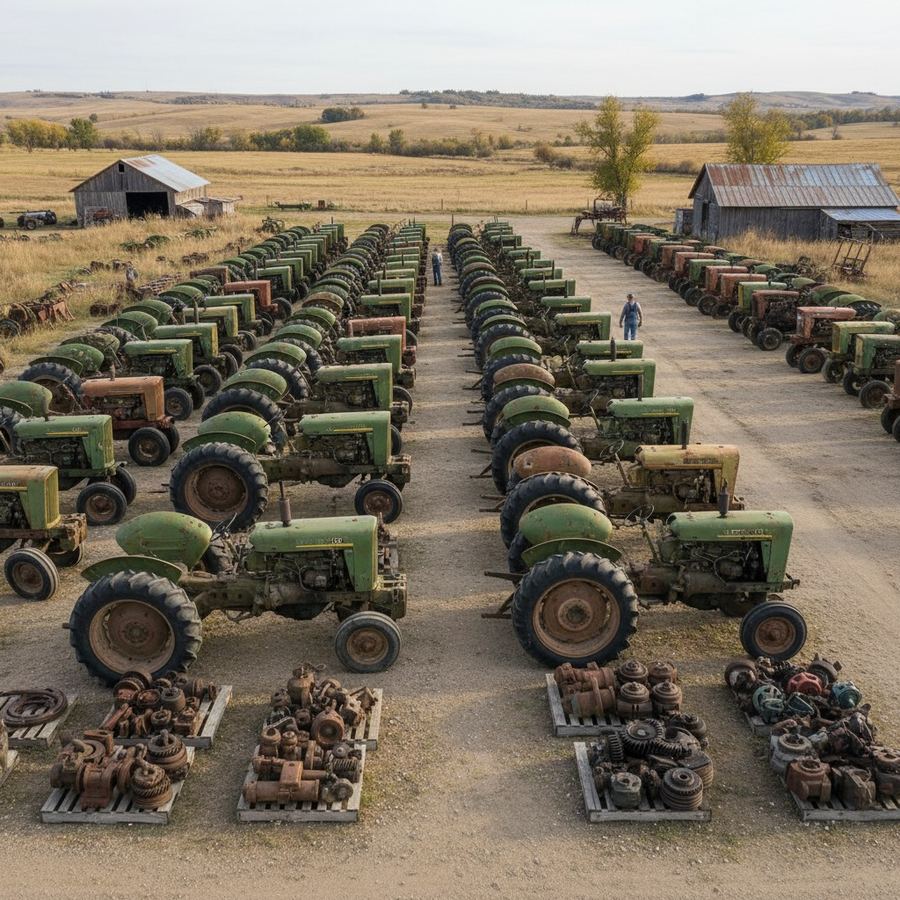
Ag salvage is its own universe. Worthington Ag Parts (formerly All States Ag Parts) runs multiple yards across the Midwest and ships nationally. They have a searchable online inventory that covers thousands of dismantled machines. Frank's Tractor Salvage, Plank's Tractor Parts, and a dozen regional yards across Kansas, Nebraska, Iowa, and the Dakotas specialize in used castings, used sheet metal, used transmissions, and used rear ends that would cost a fortune new.
Call them. Do not email and expect a quick response. The guy who knows what is on the yard is usually not at a desk. Have your casting numbers, your serial number, and your model identification ready before you dial. A used hydraulic pump from a tractor with 3,000 hours might run $150 to $400 versus $800 to $1,200 new, and if you get one from a machine that was parked running, it is often better than a rebuilt pump of unknown provenance.
Online Communities: The Free Shop Manual
The forums do two things no dealer or catalog will do: they tell you which part number actually fits your serial-number break, and they tell you which aftermarket part is garbage. Yesterday's Tractor Co.'s forums are organized by brand and have a search function that will find threads from 2003 that solve your exact problem. Tractor By Net is broader and has stronger compact tractor coverage. AnythingTractors and Red Power (for IH) have deep brand-specific knowledge.
Post your question with the model, serial number, a photo, and what you have already tried. You will get answers from people who rebuilt the same machine last winter. This is also where you find out that the new reproduction steering sector for your model is dimensionally wrong on the current production run, so go buy an NOS one from the guy in Ohio instead.
NOS, Reman, and Aftermarket: What to Buy When
NOS (New Old Stock) means a genuine OEM part that has been sitting on a shelf since the tractor was new. For things like electrical components, seals, and precision-machined pieces, NOS is often the best part you can buy if you can find it. Prices vary wildly. A NOS voltage regulator for a 1965 JD might be $45 from a retiring mechanic's estate sale or $180 from a specialist.
Reman (remanufactured) is an old core that has been rebuilt to spec. Starters, alternators, injection pumps, hydraulic pumps, and water pumps are the classics. Quality varies by the rebuilder, not by the brand name on the box. Ask around before you buy a reman injection pump from a no-name source.
Aftermarket new is the default for most wear parts: filters, belts, hoses, bearings, seals, gaskets, bushings, brake linings, clutch discs. Brand names you can trust include Timken, SKF, NAPA Premium, Donaldson, Gates, Fel-Pro, and Victor Reinz. No-name Chinese bearings are a coin flip; sometimes they are fine, sometimes they fail at 40 hours.
Casting Numbers and Part Identification
Every major casting on an old tractor has a number on it. On Ford tractors it is stamped or cast into the block, the transmission case, the rear axle housing, and the front axle. On JD it is similar. These numbers are how you verify that the block in the tractor you are looking at is actually a 201 cubic inch block and not something swapped in from a different year. They are also how you search salvage yards and forums effectively.
Get a wire brush, clean the castings, and photograph the numbers in good light. Write them down in a notebook by location. When you call a salvage yard or a parts specialist, give them the casting number, not just the model year, because a 1970 Ford 4000 had three different engine options across the production run and the parts are not interchangeable.
A Practical Sourcing Order
For most legacy parts jobs, work through the sources in this order. Check the forums first to find out what you actually need and who makes a good version of it. Check Worthington Ag and regional salvage yards for the big expensive stuff. Check Steiner, Yesterday's Tractor Co., and the other aftermarket houses for wear parts and reproduction pieces. Check the OEM dealer last, unless it is something critical where OEM is the only safe bet (injector nozzles, timing gears, anything inside the injection pump).
If you are just starting out with an older machine and want to know what wear items to budget for, our maintenance basics for older machines piece has the full list. For the inspection process that tells you what parts you are going to need before you buy the tractor at all, see the pre-purchase inspection guide and the notes on common red flags in equipment listings. And if you are buying through an auction rather than a dealer, the writeup on auction versus dealer purchases covers the differences in what parts support you will actually get.