A 1972 Ford 4000 with 6,800 hours on the clock does not want the same maintenance a 2022 utility tractor wants, and treating it like one is how you put a rod through the side of the block. Older machines were built loose, ran hotter, and were designed around oils and coolants that in some cases are no longer sold at the co-op. If you own or are about to buy a tractor built before roughly 2000, the service intervals in the owner's manual are still mostly right, but the fluids, filters, and habits around them need a little interpretation. Here is what actually matters.
Engine Oil: The Detergent Argument That Will Not Die
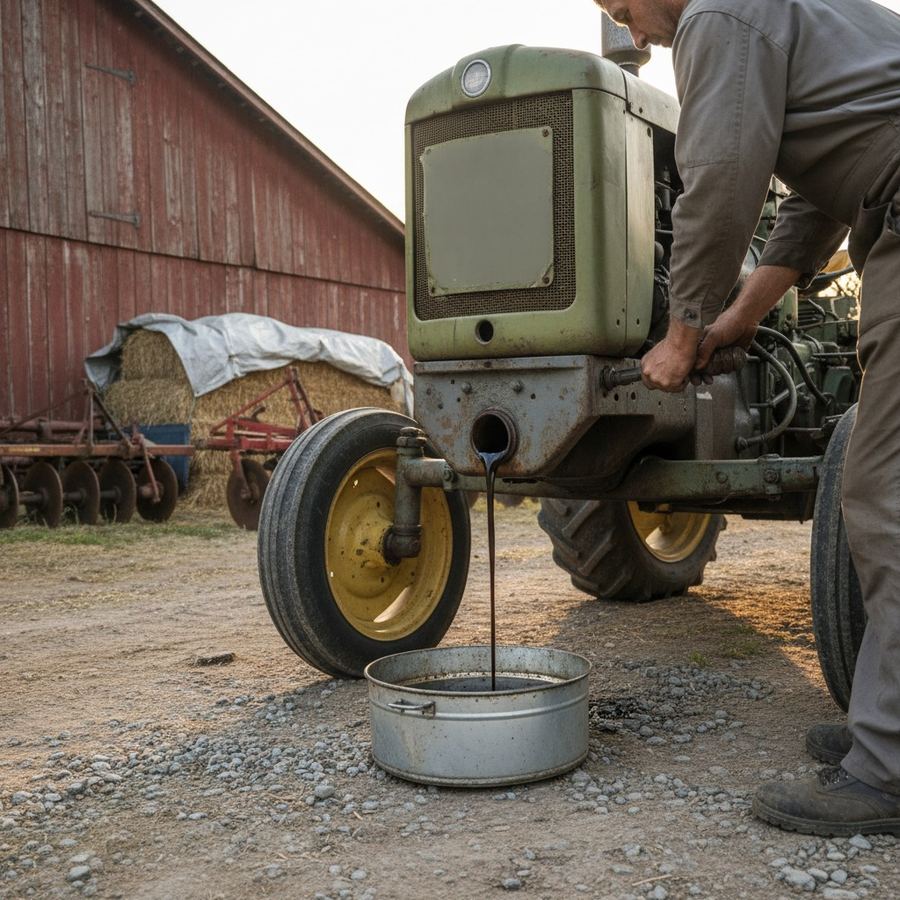
Every forum thread about pre-1970 tractors eventually arrives at the same fight: non-detergent versus detergent. The short version is that genuinely old engines, think Farmall H, 8N Ford, early Allis WD, were designed to operate on straight-weight non-detergent oil (SAE 30 ND is still stocked by TSC and NAPA for exactly this reason). Detergent oil in those engines can loosen decades of sludge that has been acting as a seal, and the results are dirty bypass filters, smoking, and occasionally a stuck ring set. If a tractor has been running detergent oil its whole life, keep running detergent oil. If it has been running ND since Eisenhower was in office, do not switch.
By the 1960s most farm diesels wanted a detergent oil, and by the 1970s 15W-40 heavy-duty diesel engine oil (CF or CF-4 rated, what Shell Rotella, Delo, and Mobil Delvac have sold for years) is the right answer for a Perkins, a Cummins B, an early JD 300-series, or a Kubota D950. Change intervals in the manual were typically 100 to 150 hours, and that is still reasonable if you run a decent filter. Short-trip duty, dusty tillage work, or a tractor that idles a lot at PTO should see 75 hours.
Filters and the Art of Reaching Them
Some of the worst filter placements in human history belong to 1960s and 70s tractors. The oil filter on a Massey 135 Perkins is a cartridge buried behind a cast housing on the right side of the block. The fuel filter on a JD 4020 sits where you need a long arm and a good flashlight. Factor this into your service time, and plan to replace every gasket and o-ring you disturb, because half of them will not seal a second time.
Buy the right cross-reference. NAPA Gold, WIX, Donaldson, and Baldwin all make filters for most legacy tractors, and the box will list the OEM number. For obscure brands (Oliver, Cockshutt, David Brown, Zetor), aftermarket specialists like Steiner Tractor Parts and Yesterday's Tractor Co. carry cross-referenced filters that the auto parts store counter has never heard of.
Grease Points: You Will Miss Some
A typical 1970s utility tractor has somewhere between 18 and 35 grease zerks. A loader tractor pushes that past 50. The manual will tell you daily for working machines, weekly for light duty. Nobody actually does daily. What you should do is hit the front axle pivots, king pins, steering cylinder ends, loader pins, and 3-point links every tank of fuel, and do the rest once a month.
Use a good NLGI #2 lithium complex grease for most points. For the front axle king pins and loader pins on hard-working tractors, moly-fortified grease lasts longer. Do not mix red and green greases; they are not always compatible and can turn to soup. The zerks you will forget are usually the driveline slip joint, the clutch release cross-shaft (often accessed through a hole in the bellhousing), and the steering shaft bushings. Find them once, mark them with paint, and you will stop missing them.
Hydraulic and Transmission: The Shared Sump Problem
Most tractors from the 60s onward share hydraulic and transmission fluid in a single sump. This is why Universal Tractor Transmission Oil (UTTO) exists. It is a compromise fluid designed to work as a hydraulic fluid, a wet-brake fluid, a final-drive gear oil, and a power-shift transmission fluid all at once. Good UTTO from CaseIH Hy-Tran, JD Hy-Gard, or equivalent (the NAPA store-brand UTTO is usually fine) is the right answer. Do not pour straight 90W gear oil into a shared sump, and do not use ATF unless the manual specifically calls for it (some small Kubotas do).
Change it every 600 to 1000 hours, or every two years if the machine is lightly used. Pull the sump screens at the same time, because they will be fuzzy with wear metal and you want to see what is coming off the gears.
Coolant: Brass Radiators Are Not Modern Radiators
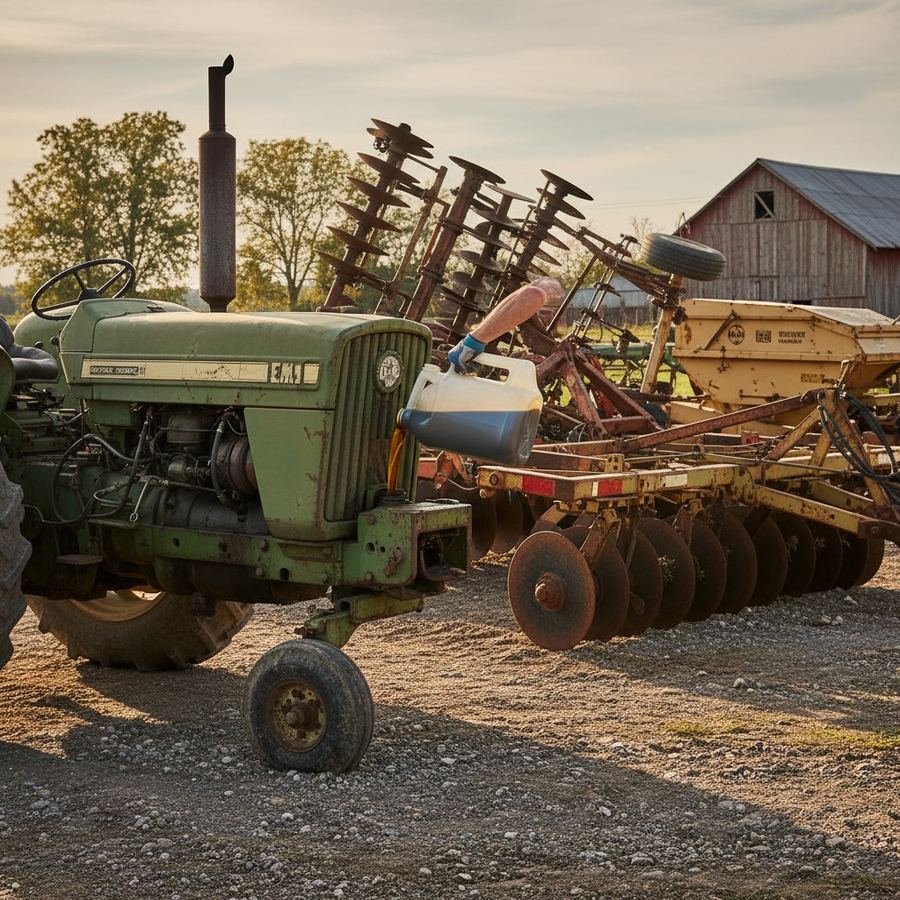
Extended-life coolant (OAT, the orange stuff) is formulated for modern aluminum radiators and will attack the solder joints on a brass and copper radiator over time. Tractors with original brass radiators want conventional green ethylene glycol mixed 50/50 with distilled water. Change it every two years, not every five, and if you see brown sludge when you drain it you have been running hard water in there.
Pressure test the cap. A 7 PSI cap that cannot hold 5 PSI is going to cost you a head gasket the next time you pull a heavy load up a hill on a July afternoon. Replacement caps are a few dollars.
Diesel Fuel System: Annual Service Is Not Optional
Older diesels with Stanadyne DB or Bosch VE injection pumps will run for 10,000 hours if you keep clean fuel in them and kill them fast if you do not. Change the primary and secondary fuel filters every year minimum, even on a low-hour tractor. Drain the fuel filter water bowls monthly during use, weekly in humid climates. A biocide additive a couple of times a year will prevent the black slime that clogs pickup screens after a tractor sits with half-full tanks through a wet spring.
If you start chasing hard-start or rough-run symptoms, do the filters first, the lift pump second, and the injectors third before you touch the injection pump. A rebuilt Stanadyne DB2 runs $600 to $1100 at a specialist shop, and you want to be sure that is what you need before you pull it. Our notes on what to check on older diesel tractors cover the full inspection sequence.
Winter Storage: Running It Once a Month Is the Worst Thing You Can Do
Starting a cold stored tractor, letting it idle in the yard for ten minutes, and shutting it off is the single most destructive thing you can do to it. The engine never gets hot enough to burn off the water and fuel in the crankcase, the exhaust system fills with condensation, the injection pump runs without reaching operating temperature, and moisture accumulates everywhere. Then you shut it off and let it freeze.
Correct winter storage is: fuel tank topped off with stabilizer, fresh oil and filter before storage (not after, because you do not want old acidic oil sitting on bearings all winter), grease everything, chock the wheels and release the parking brake so the linings do not rust to the drums, pull the battery and keep it on a tender somewhere warm, and leave it alone until spring. If you must run it, run it for at least 30 minutes at working load, not idling in the driveway.
The Boring Stuff That Saves Engines
Check the air filter before every serious job. Dirty air filters kill more old diesels than anything else, because when they collapse or get bypassed, abrasive dust goes straight into the turbo and cylinders. A pre-cleaner on a dusty operation is worth its weight. Check the radiator screen for chaff before running in hay. Check belt tension and look for fraying. Keep the battery terminals clean (baking soda and water, wire brush, dielectric grease). Keep water out of the cab, because that is how you rot the floor and the wiring harness.
None of this is expensive. All of it is the difference between a tractor that runs for another 30 years and a tractor that becomes a parts donor next season. If you want a broader framework for evaluating a used machine before you buy, the pre-purchase inspection checklist and the notes on what hours really mean are worth reading alongside this. For sourcing the actual parts you will need, see where to find parts for legacy tractor models.